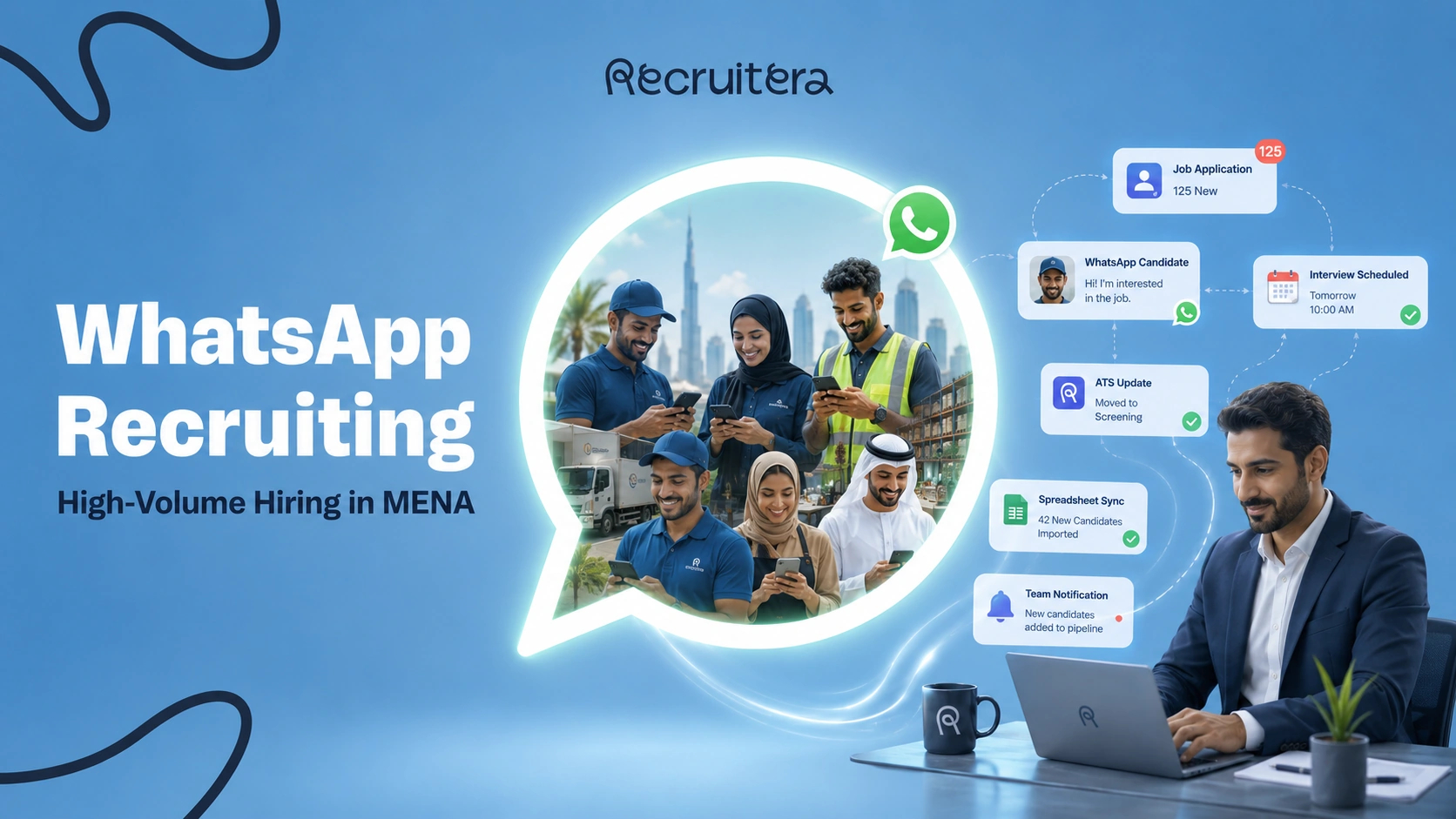

WhatsApp recruiting is the practice of sourcing, screening, scheduling, and communicating with candidates over WhatsApp instead of, or alongside, email and phone calls. In markets like Egypt and the Gulf, where WhatsApp is the default messaging channel for most of the workforce, it has become the fastest way to reach candidates and keep them engaged through the hiring process.
For high-volume hiring — retail floor staff, delivery riders, call-centre agents, warehouse workers, seasonal teams — the advantage is simple: you meet candidates on the channel they already open dozens of times a day, rather than the inbox they check once a week, if ever.
Why email is quietly failing high-volume hiring in MENA
Most applicant tracking systems were built around email as the primary candidate channel. That assumption breaks down badly in this region, and the numbers show it.
Blue-collar and frontline candidates often don't have an actively-monitored email address at all. Even when they do, open rates are low and reply times are slow. By the time a candidate reads your interview invitation, they've frequently already accepted a role somewhere that moved faster. In high-volume hiring, where you might be filling 50 roles at once, that lag compounds into weeks of lost pipeline.
WhatsApp inverts the entire dynamic. Messages are typically read within minutes. Replies come back in conversational, low-friction bursts. And the channel is already trusted — candidates don't treat a WhatsApp message as spam the way they treat an unknown email. If you want the side-by-side data on this, see our breakdown of why WhatsApp outperforms email for recruiting roles.
Where WhatsApp adds the most value in the funnel
WhatsApp isn't an all-or-nothing switch. The teams getting the most out of it apply it to the specific stages where speed and reachability matter most.
Sourcing and first contact. Career-page applicants and job-board leads can be routed straight into a WhatsApp conversation instead of an email auto-reply. The candidate is engaged while their interest is still warm.
Screening. Simple qualifying questions — location, availability, salary expectation, right to work — can be asked and answered in a short WhatsApp exchange, filtering out mismatches before a recruiter spends time on them.
Interview scheduling. Self-scheduling links and reminders sent over WhatsApp dramatically cut no-shows compared to email invitations. Candidates confirm, reschedule, and show up because the reminder lands somewhere they'll actually see it.
Reducing drop-off and ghosting. A large share of candidate ghosting in this region is simply candidates not seeing your messages. Moving updates to WhatsApp closes that gap. For the full playbook on this, read our guide to candidate ghosting and drop-off.
WhatsApp for blue-collar and frontline hiring
The single clearest use case is blue-collar and frontline recruiting. This is where the email assumption fails hardest and where WhatsApp's advantage is largest.
Warehouse staff, drivers, retail associates, security personnel, and hospitality workers live on WhatsApp and rarely on email. A hiring process built around WhatsApp — application confirmation, screening questions, interview slot, reminders, and offer, all in one thread — matches how these candidates actually communicate. The result is a faster fill rate and a much lower drop-off between application and start date. We go deeper on this specific segment in reaching blue-collar talent with a WhatsApp-native ATS.
The WhatsApp Business API: what recruiting teams need to know
There's an important distinction between the free WhatsApp Business app and the WhatsApp Business API, and it matters once you're hiring at any real scale.
The consumer app works on a single phone and doesn't scale — it can't be shared cleanly across a recruiting team, it has no proper automation, and it gives you no reporting. The WhatsApp Business API, provided through Meta, is what powers legitimate high-volume recruiting: multiple recruiters working from one business number, automated template messages, and integration with your hiring software.
Two practical points teams should understand before starting:
- Template messages vs. session messages. Business-initiated messages (like an interview invite sent out of the blue) must use pre-approved templates. Once a candidate replies, you have a 24-hour session window for free-form conversation. Structuring your outreach around this rule is central to doing WhatsApp recruiting properly.
- Message categories and cost. Meta prices conversations by category (utility, marketing, etc.). Recruiting messages need to be categorized correctly to stay compliant and cost-effective.
For the technical setup and the rules in plain language, see our guide to the Meta WhatsApp Business API for HR teams and our WhatsApp templates: utility vs. marketing guide.
Shared phone vs. ATS-native WhatsApp: why the integration matters
Plenty of teams start WhatsApp recruiting with a single shared phone passed between recruiters. It works for a handful of hires and then falls apart.
With a shared phone, conversations live outside your hiring system. There's no record of who said what to which candidate, no link between the WhatsApp thread and the candidate's pipeline stage, no reporting, and total chaos the moment two recruiters are working the same number. When a recruiter leaves, their conversations leave with them.
An ATS-native WhatsApp integration solves this by making WhatsApp a channel inside your applicant tracking system rather than a separate app. Every conversation is attached to the candidate's profile. Messages are logged against the pipeline. The whole team has visibility. Templates, scheduling, and automated reminders run from the same place you manage the rest of the hire.
This is the core of how Recruitera approaches conversational hiring: WhatsApp isn't bolted on, it's built into the pipeline. To see where this fits in the bigger shift, read the future of hiring in Egypt and conversational recruiting.
A practical WhatsApp high-volume hiring workflow
Here's what a clean, scalable WhatsApp recruiting workflow looks like for a high-volume role, end to end:
- Candidate applies via your career page or a job board.
- Instant WhatsApp confirmation replaces the email auto-reply, keeping the candidate engaged immediately.
- Automated screening questions qualify the candidate on the essentials (location, availability, expectation).
- Qualified candidates get a self-scheduling link over WhatsApp to book an interview slot.
- Automated reminders go out before the interview, cutting no-shows.
- Offer and next steps are delivered and tracked in the same thread.
- Everything is logged against the candidate's profile in the ATS, with full team visibility and reporting.
For very large hiring pushes, this is what makes the difference between a process that scales and one that collapses under its own volume. Our take on rethinking enterprise high-volume hiring covers how this workflow holds up at scale.
Getting started without overcomplicating it
You don't need to rebuild your entire hiring process to start. The highest-return first step is almost always moving interview scheduling and reminders to WhatsApp for one high-volume role, measuring the drop in no-shows, and expanding from there.
Start with a single role family. Move confirmations, screening, and scheduling to WhatsApp. Track no-show rate and time-to-fill against your email baseline. The improvement usually makes the business case for broader rollout on its own.
Frequently asked questions
Is WhatsApp recruiting allowed under Meta's rules?
Yes, when done through the official WhatsApp Business API with approved message templates and correct opt-in. The consumer WhatsApp app is not designed for scaled business messaging; the Business API is the compliant route for recruiting teams.
Do candidates need to opt in to receive WhatsApp messages?
Yes. Best practice, and Meta's requirement for business-initiated messages, is to collect opt-in at the point of application. Once a candidate messages you first, a 24-hour conversation window opens for free-form replies.
Is WhatsApp only useful for blue-collar hiring?
No. It delivers the biggest gains in blue-collar and high-volume hiring because those candidates rarely use email, but it also improves speed and reduces no-shows across white-collar roles. The advantage is reachability, which applies everywhere in MENA.
What's the difference between the WhatsApp Business app and the Business API?
The app runs on one phone with no real automation, sharing, or reporting. The Business API supports multiple recruiters on one number, automated templates, and integration with your ATS — which is what you need for high-volume hiring.
Why use an ATS with WhatsApp built in instead of a separate WhatsApp tool?
An ATS-native integration attaches every conversation to the candidate's profile and pipeline stage, gives the whole team visibility, and keeps your reporting and hiring data in one place. A separate tool or shared phone leaves conversations disconnected from your hiring records.
Turn WhatsApp into your hiring advantage
In MENA, the teams filling high-volume roles fastest aren't the ones with the biggest job-board budgets — they're the ones reaching candidates where they already are. Recruitera puts WhatsApp inside your ATS, so sourcing, screening, scheduling, and offers all happen in one conversation, fully tracked.
Book a demo and see WhatsApp hiring work end to end.
جاهز للتوظيف بذكاء أكبر؟
يساعدك ريكروتيرا على رؤية الشخص وراء السيرة الذاتية. احجز عرضًا توضيحيًا سريعًا واكتشف طريقة أفضل لبناء فريقك.
احجز عرضًا توضيحيًا

مركز المعرفة الأول لمسؤولي التوظيف.
تصفّح الموارد ←أدلة عملية حول استقطاب المواهب وإجراء المقابلات وبناء العلامة التوظيفية في المنطقة.
اقرأ المدونة ←أوصاف وظيفية وخطابات عروض عمل وبطاقات تقييم للمقابلات وقوائم تهيئة الموظفين الجدد، جاهزة للنسخ.
تصفّح القوالب ←