5 Roles Where WhatsApp Outperforms Email for Recruiting (With Data)
5 Roles Where WhatsApp Outperforms Email for Recruiting (With Data)

Introduction
Email became the default recruiting communication channel not because it was the best channel for every candidate — but because it was the most systematic. For a significant portion of the roles that dominate hiring volume in Egypt today, it does not work. The issue is not email as a technology. It is email as an assumption — the assumption that your candidate checks it regularly, responds to it promptly, and uses it as their primary channel for professional communication.
Role 1 — Factory and Production Workers
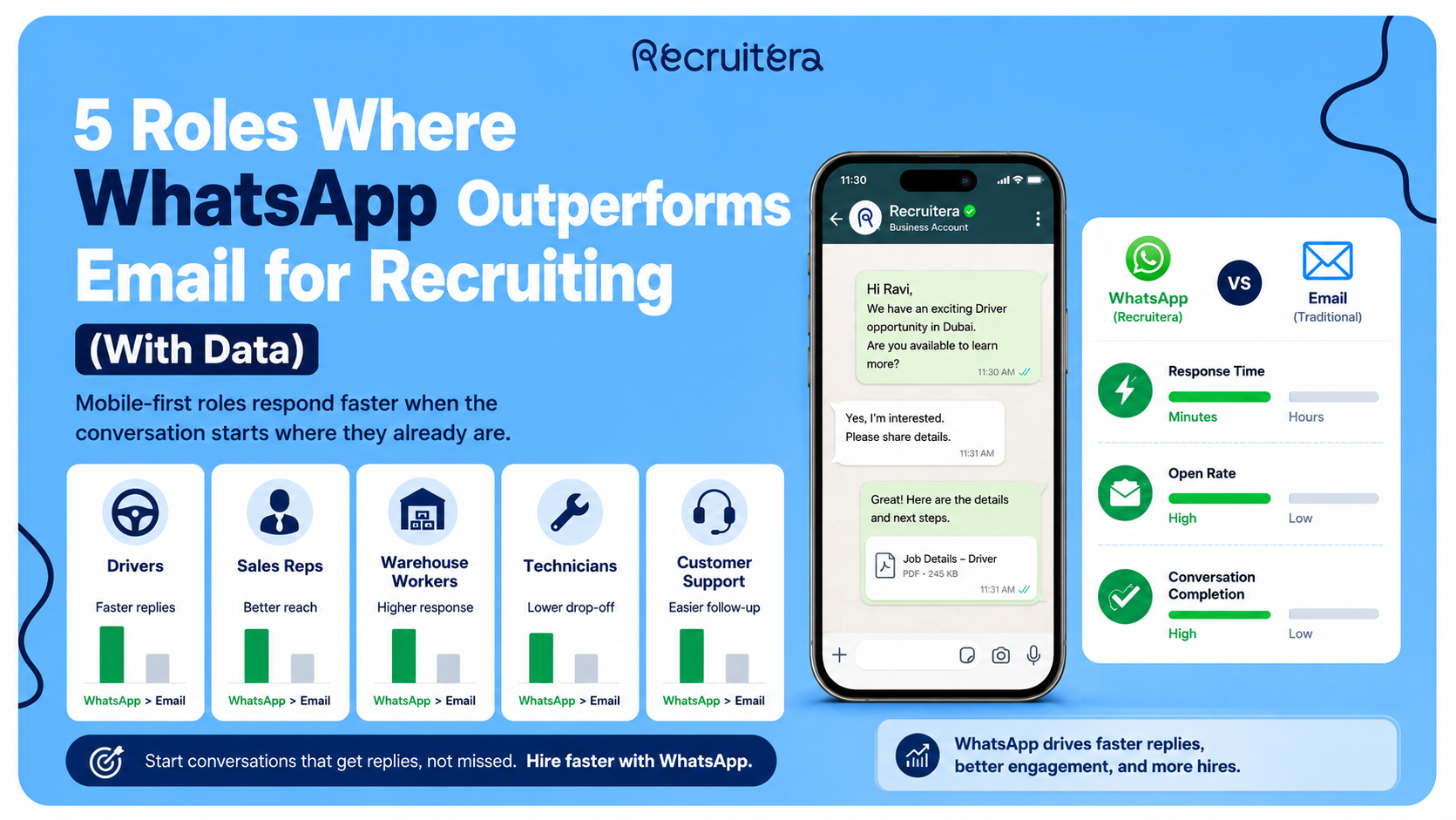
A significant portion of this candidate pool does not use email as a primary communication channel. For many, email is a credential rather than a communication tool. WhatsApp Hiring is where they are — job opportunities are shared in WhatsApp groups, work arrangements are discussed via WhatsApp, and when a recruiter reaches out on WhatsApp, they are communicating in the channel the candidate actually uses. An interview invitation sent via email to a factory worker candidate may sit unread for days. The same invitation sent via WhatsApp is typically seen within minutes.
Role 2 — Sales Representatives
Sales candidates are typically more digitally active than blue collar candidates and more likely to check email. But they are also more likely to be actively interviewing at multiple companies simultaneously — and more likely to accept an offer from whoever reaches them first. In high-turnover sales hiring, speed-to-contact is the primary variable determining offer acceptance. WhatsApp messages are read in under three minutes on average. See: WhatsApp Hiring for high-volume white collar roles.
Role 3 — Customer Service and Call Center Agents
Customer service and call center recruiting shares many characteristics with sales hiring — high volume, high turnover, competitive candidate markets. Inbound applications via WhatsApp have higher completion rates than online applications, particularly for candidates applying on mobile devices. Outbound follow-up via WhatsApp generates faster responses than email — important when the same candidates are receiving interview invitations from multiple companies.
Role 4 — Retail and Hospitality Staff
Retail and hospitality hiring in Egypt has a specific characteristic that makes WhatsApp particularly effective — a high proportion of candidates are referred. A current employee mentions a job opening to a friend or family member. The friend messages the company's WhatsApp number. This referral-to-WhatsApp pipeline is already happening at most retail and hospitality companies — informally, via recruiter personal phones.
Role 5 — Drivers and Logistics Staff
Driver and logistics recruiting sits at the intersection of two factors that make email particularly ineffective — a candidate pool with low email usage rates and a role with extremely high demand and competition for qualified candidates. Experienced drivers are in high demand across Egypt's growing logistics sector. They are not sitting at desks checking email between shifts. They are on the road — reachable via the mobile device they carry with them.
The Data Behind the Claim
WhatsApp messages have an open rate estimated at over 90 percent compared to email open rates that typically range from 20 to 30 percent for recruiting communications. The average WhatsApp message is read within three minutes of receipt. Email response times in recruiting contexts are typically measured in hours at best, and often in days.
Frequently Asked Questions
What is the average response rate for WhatsApp recruiting messages compared to email?
Broadly, WhatsApp messages achieve open rates estimated above 90 percent, compared to email open rates that typically range from 20 to 30 percent for recruiting communications — and often lower for blue collar and entry-level candidate profiles.
Should I completely replace email with WhatsApp in my recruiting process?
Not necessarily. WhatsApp significantly outperforms email for blue collar, high-turnover white collar, and field roles where the candidate pool is mobile-first. For professional, specialist, and executive roles where candidates are desktop-active and email-comfortable, email remains effective. The most effective recruiting operations use both channels, with the choice matched to the candidate profile.
How do I get candidates to message our company WhatsApp number in the first place?
For referral-driven hiring, share the company's WhatsApp number with current employees and ask them to pass it to interested contacts. For roles with physical locations, display the WhatsApp number prominently for walk-in inquiries. QR codes linking directly to a WhatsApp conversation are particularly effective in physical environments.
Further Reading
Also read: Why Blue Collar Hiring in Egypt Is Broken and WhatsApp vs. Job Boards: Which Channel Actually Works for High-Volume Hiring in MENA?. Learn how to set up the automated bot and enable bulk send.
Conclusion
Email is not a bad recruiting tool. For the right candidate in the right context, it is effective and appropriate. But for the five role types described in this article, the assumption that email is the best channel is not supported by candidate behavior. WhatsApp is where these candidates are. It is how they communicate. And for roles where speed-to-contact is directly correlated with offer acceptance, reaching candidates first on the channel they check most frequently is not a marginal advantage — it is a decisive one.
Huda Khaled is a Product Marketing professional at Recruitera, a MENA-focused applicant tracking system built by Basharsoft Group.
Ready to Hire Smarter?
Recruitera helps you see the person behind the resume. Book a quick demo and discover a better way to build your team.
Book a Demo

Recruiters' first go-to knowledge hub.
Visit resources →Practical guides on sourcing, interviewing and employer branding in MENA.
Read the blog →Job descriptions, offer letters, interview scorecards and onboarding checklists, ready to copy.
Browse templates →New features, improvements and release notes from the Recruitera team.
See what's new →