The Future of Hiring in Egypt: Conversational Recruiting at Scale
The Future of Hiring in Egypt: Conversational Recruiting at Scale

Introduction
Recruiting has always been a conversation. A hiring manager describes what they need. A recruiter goes to find it. A candidate tells their story. A decision gets made. The process, at its core, is human and conversational — even when it is buried under layers of forms, job boards, ATS workflows, and email chains that make it feel like anything but.
The next evolution of recruiting in Egypt is not about adding more technology to that process. It is about removing the layers that have accumulated between the conversation and the outcome. Conversational recruiting is what happens when the hiring process happens in the channel where conversations already happen. In Egypt, that channel is WhatsApp. And the companies that understand this are not waiting for the future to arrive. They are building it now.
What Conversational Recruiting Actually Means
Conversational recruiting is not chatbots on career pages. It is the use of messaging channels — specifically, the channels candidates actually use — as the primary interface for the hiring process. In this model, a candidate applies by sending a message. They are screened through a conversation. They schedule their interview in a chat. They receive updates in the same thread. The technology behind this — automated bots, template messaging, ATS integration — is infrastructure. The experience for the candidate is a conversation.
Where Egypt Is Now
Egypt is at an interesting inflection point in hiring technology adoption. The formal infrastructure — ATS platforms, job boards, career pages — exists and is used by a significant portion of mid-to-large employers. But the informal reality of how hiring actually happens, particularly for blue collar and high-turnover roles, has not been integrated into that formal infrastructure. WhatsApp Hiring is happening everywhere in Egypt — from personal phones, in informal ways, without tracking or governance. The channel is working. The problem is that the infrastructure around it does not exist for most companies.
The Candidate Experience Driving the Shift
In the current model for blue collar hiring: a candidate hears about a job, is directed to a career page, begins an online application, encounters friction, and a significant percentage abandon the process. The ones who complete it submit an application and wait for an email they may or may not see. The process stretches over days.
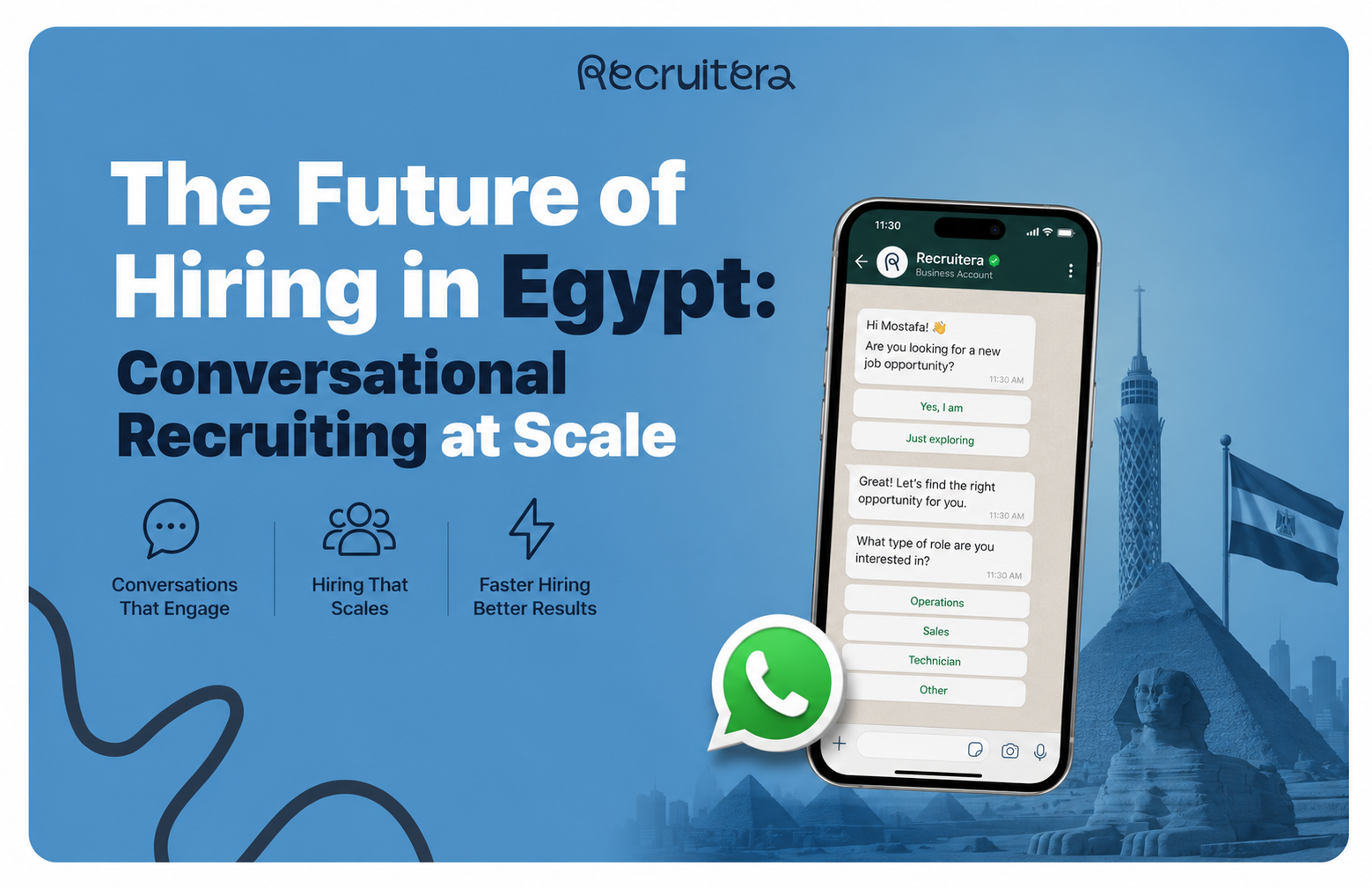
In the conversational model: a candidate hears about a job. They send a WhatsApp message to the company number. They receive an instant response. They answer three screening questions in the same conversation. They select an interview slot. They receive a confirmation. The entire process takes minutes. The candidate experience improvement is not marginal. It is fundamental.
What Comes Next
Richer candidate screening in conversation. Future iterations will support voice notes, document sharing, and video messages — all within the WhatsApp interface candidates already use.
Proactive talent pool engagement. The talent pool of pre-screened, WhatsApp-reachable candidates becomes increasingly valuable as it grows. Future hiring flows will maintain ongoing relationships with candidates who are not currently looking, surfacing relevant opportunities when they arise.
Multi-language and dialect support. Future WhatsApp hiring flows will be more sophisticated in language handling — detecting the candidate's preferred communication style and adapting accordingly.
Integration with broader HR operations. As WhatsApp becomes a standard hiring channel, its integration with other HR processes will deepen — onboarding, document collection, first-day logistics, and check-ins via WhatsApp.
Data-driven sourcing decisions. As WhatsApp hiring data accumulates in ATS platforms over months and years, the patterns it reveals will drive increasingly sophisticated sourcing decisions.
The Companies That Will Win
The future of hiring in Egypt belongs to companies that understand two things. First, that the candidate is the constraint. The best hiring technology is the technology that reaches the candidate where they are. Second, that the talent pool is the asset. The cumulative effect of every well-managed WhatsApp hiring interaction — every candidate screened, logged, and added to the talent pool — builds something more durable than any single hire. The company that builds this pool fastest has the most durable competitive advantage in high-volume hiring.
Frequently Asked Questions
What is conversational recruiting?
Conversational recruiting is the use of messaging channels — specifically the channels candidates use for everyday communication — as the primary interface for the hiring process. Instead of directing candidates to online application forms and email-based communication, conversational recruiting allows candidates to apply, be screened, schedule interviews, and receive updates through messaging apps like WhatsApp. The technology behind the process is invisible to the candidate, who experiences hiring as a natural conversation rather than a formal administrative procedure.
Is conversational recruiting appropriate for all roles?
Conversational recruiting is most effective for high-volume roles where the candidate pool is mobile-first — blue collar roles, sales, customer service, logistics, retail, and hospitality. For executive, specialist, and senior professional roles where the candidate pool is smaller and the depth of evaluation required extends beyond what a conversational screening can assess, traditional recruiting processes remain appropriate.
How does conversational recruiting affect the quality of hires?
Conversational recruiting improves hire quality in several ways. It reaches a broader candidate pool, increasing the probability of finding the right fit. It screens candidates faster and more consistently. And it reduces no-show rates — candidates who confirmed their interview slot in a WhatsApp conversation are more likely to attend than those who responded to an email invitation days earlier.
Further Reading
Also read: Why Blue Collar Hiring in Egypt Is Broken, The Hidden Cost of Manual WhatsApp Hiring, and 5 Roles Where WhatsApp Outperforms Email for Recruiting. Enable bulk send to activate your talent pool at scale.
Conclusion
Conversational recruiting is not a trend or a technology experiment. It is the natural direction of a market that has always been about human connection. In Egypt, WhatsApp is the channel. The infrastructure is here. The companies moving first are building advantages that will compound. The future of hiring in Egypt is conversational. The present is where that future starts.
Huda Khaled is a Product Marketing professional at Recruitera, a MENA-focused applicant tracking system built by Basharsoft Group.
Ready to Hire Smarter?
Recruitera helps you see the person behind the resume. Book a quick demo and discover a better way to build your team.
Book a Demo

Recruiters' first go-to knowledge hub.
Visit resources →Practical guides on sourcing, interviewing and employer branding in MENA.
Read the blog →Job descriptions, offer letters, interview scorecards and onboarding checklists, ready to copy.
Browse templates →New features, improvements and release notes from the Recruitera team.
See what's new →