Best ATS for SMEs in 2026: The Complete Guide for Growing Businesses
Looking for the best ATS for your small business orSME? We review the top options by use case, price, and features — including the best pick for MENA businesses

Quick answer: The best ATS for a small business depends on your hiring volume, team size, and market. For global SMEs, Workable, Teamtailor, and Recruitee are strong all-rounders. For businesses hiring in Egypt and the MENA region, Recruitera is purpose-built for the market — with Arabic career pages, WhatsApp integration, and local job board connectivity that no Western platform comes close to matching.
Every small business eventually reaches the same wall.
You're growing. You've got open roles. You're getting CVs on WhatsApp, email, and LinkedIn simultaneously. The hiring manager has one view, the recruiter has another, and nobody's sure which candidate is at which stage. Someone good slips through and accepts a competing offer while you were waiting for internal alignment.
That's the moment most SMEs start looking for an ATS.
The problem: the market is built for enterprises. Most ATS platforms are priced for companies with full-time recruiting teams, dedicated HRIS admins, and multi-month implementation timelines. The ones marketed as "SME-friendly" often strip out features you actually need. And almost none of them are built for markets like Egypt, Saudi Arabia, or the UAE — where job boards, candidate communication norms, and hiring workflows are fundamentally different.
This guide gives you the honest picture: what to look for in an ATS as a small or mid-sized business, what the leading global platforms offer, and why MENA businesses need to think about this differently.
What Makes an ATS Right for a Small Business?
Enterprise ATS tools and SME ATS tools solve different problems. Before evaluating any platform, get clear on what you actually need.
1. Speed of Setup
A small business doesn't have three months to implement software. The right SME ATS should be live — with your jobs posted, your pipeline configured, and your team trained — in days, not weeks. If a vendor's sales process includes a "discovery call," a "scoping session," and a "rollout plan," it's probably not built for your stage.
2. Simple Pricing
Enterprise ATS platforms charge per seat, per requisition, or with complex tier structures that balloon as your team grows. SME-friendly tools typically offer flat monthly pricing based on active job slots or employee count — predictable and budget-friendly.
3. Recruiting-Focused Features (Not HR Suite Bloat)
Small businesses often get sold all-in-one HR platforms when what they actually need is a clean recruiting workflow. An ATS should do recruiting excellently: job posting, pipeline management, candidate communication, interview scheduling, and offer management. If it also does payroll and performance management — but does recruiting badly — it's the wrong tool.
4. Ease of Use for Non-Recruiters
In a small business, the hiring manager is often the operations director, a department head, or the founder. They don't have time to learn complex software. The ATS needs to be intuitive enough that a non-recruiter can review candidates, leave feedback, and approve next steps without training.
5. Job Board Integrations That Match Your Market
A UK-based SME needs integration with Indeed, Reed, and LinkedIn. An Egyptian SME needs integration with Wuzzuf, Bayt, and LinkedIn. An ATS that doesn't connect to the job boards where your candidates actually are is a significant operational gap — you'll end up posting manually anyway.
6. A Career Page That Doesn't Embarrass You
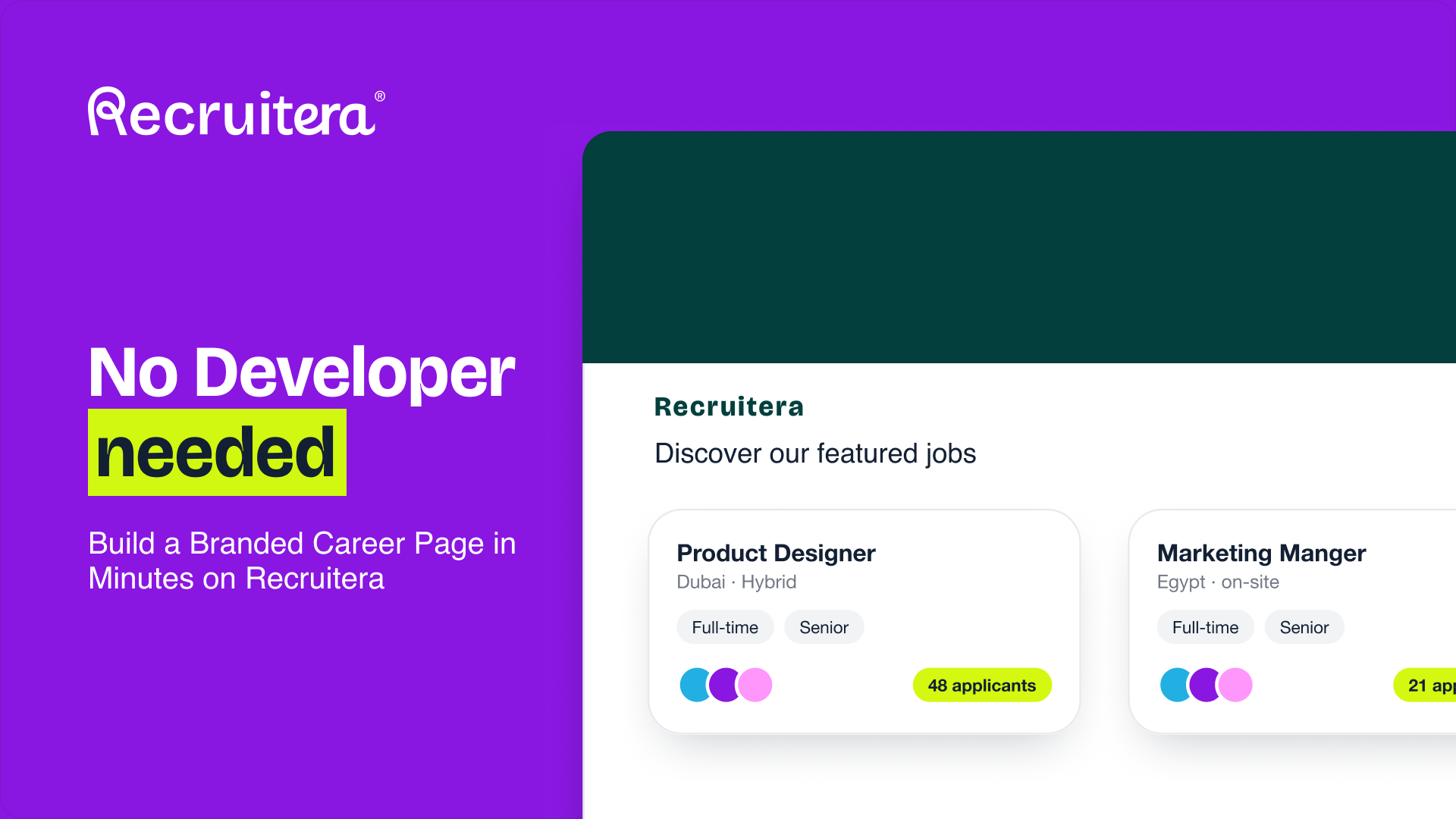
Your career page is a candidate's first impression of your company. Many SME-tier ATS tools offer basic, generic career pages. If your employer brand matters to you — and it should, especially in competitive talent markets — look for a platform that lets you build a branded, visually strong, mobile-first career page without involving a developer.
7. WhatsApp and Mobile-First Communication
In MENA, WhatsApp is the dominant communication channel. Candidates don't check email. A recruiter who can only reach out via email is already losing to the competitor who sends a WhatsApp message. For MENA businesses, WhatsApp integration isn't a nice-to-have — it's the difference between a fast hire and a lost candidate.
What to Ignore When Evaluating an ATS
AI features you won't use. Many ATS platforms now lead with AI-powered screening, predictive hiring, and machine learning models. These features require large data sets to be meaningful. A small business running 10–50 hires a year doesn't have the data to make these models useful. Prioritize workflow over AI marketing.
Per-seat pricing that scales badly. Some platforms price per user seat. At 3 recruiters it looks affordable. At 8 hiring managers it becomes expensive. Understand the total cost at your realistic user count before committing.
Implementation complexity. Any ATS that requires a dedicated implementation partner or a data migration project is overkill for a small business. You need software you can set up yourself.
Features locked behind enterprise tiers. Some platforms put the most useful features — analytics, custom pipeline stages, advanced communication tools — in higher tiers. Read pricing pages carefully and make sure what you actually need is in the tier you can afford.
The Best ATS Platforms for SMEs: An Honest Assessment
Here are the platforms most commonly evaluated by small and mid-sized businesses, what they're genuinely good at, and where they fall short.
1. Workable
Best for: Fast-growing SMEs that need a complete, reliable ATS without enterprise complexity.
Workable is one of the most widely used ATS platforms among companies in the 20–500 employee range. It covers the full hiring workflow cleanly: multi-channel job posting (200+ job boards), a customizable hiring pipeline, candidate profiles with CV parsing, collaborative feedback, interview scheduling, and offer letters. The interface is genuinely intuitive — most recruiters can get productive within a day.
Strengths: Excellent job board distribution network. Strong sourcing tools including a passive candidate database. Clean, modern interface that non-recruiters can navigate. Good analytics and reporting out of the box. AI-assisted job description writing.
Weaknesses: Pricing can escalate quickly as you add job slots. Limited career page customization on lower tiers. Not built for MENA — no Arabic career page, no WhatsApp integration, limited local job board connectivity. US/EU-centric compliance framing.
Pricing: Starts around $189/month for the Starter plan (2 active jobs). Scales significantly with job volume.
Verdict: A solid, reliable choice for global SMEs. Not the right tool for MENA businesses where local integrations matter.
2. Teamtailor
Best for: SMEs that care deeply about employer branding and candidate experience.
Teamtailor's standout feature is its career site builder — by far the most visually impressive in the SME ATS category. If your hiring strategy depends on strong employer branding, Teamtailor gives you a career site that looks like it was built by a design agency, with no coding required. The ATS functionality is solid: customizable pipelines, automated triggers, candidate nurturing sequences, and good team collaboration tools.
Strengths: Best-in-class career page builder in the SME market. Unlimited users on all plans — no per-seat pricing. Strong candidate experience focus with branded communications and automated nurturing. Good analytics and conversion tracking on the career page.
Weaknesses: Weaker sourcing tools compared to Workable. Job board integrations less extensive than competitors. Not built for MENA — no Arabic support, no WhatsApp, no local job boards. Can feel over-engineered for very small teams.
Pricing: Custom pricing based on company size. Generally in the $200–400/month range for SMEs.
Verdict: The best choice if employer branding is your primary differentiator. Overkill for early-stage small businesses.
3. Recruitee (now Tellent)
Best for: SMEs that want collaborative hiring with strong team involvement.
Recruitee (recently rebranded as Tellent) is built around the idea that hiring is a team sport. It makes it particularly easy for multiple stakeholders — hiring managers, department heads, external interviewers — to participate in the process through structured scorecards, video interviews, and role-based permissions. The pipeline is highly customizable, and the job board integrations are solid.
Strengths: Excellent team collaboration and structured scorecards. Highly customizable pipeline stages. Good job board distribution. Unlimited users on all plans. Strong EU presence and GDPR compliance.
Weaknesses: Interface can be overwhelming for very small teams. Analytics are weaker than Workable. No MENA-specific features. Higher price point relative to feature depth for small teams.
Pricing: Starts around $199/month for the Launch plan.
Verdict: Good for SMEs with multiple hiring stakeholders. Not optimized for MENA.
4. Zoho Recruit
Best for: Budget-conscious SMEs already in the Zoho ecosystem.
Zoho Recruit is the most affordable option on this list that still covers the full ATS feature set. If your business already uses Zoho CRM, Zoho People, or other Zoho products, the integration argument is strong. The feature set is comprehensive — job posting, candidate management, email automation, interview scheduling, and reporting — though the interface feels dated compared to modern competitors.
Strengths: Most affordable pricing in this category (free tier available). Deep integration with Zoho CRM and Zoho People. Comprehensive feature set for the price. Good customization options.
Weaknesses: Interface is significantly less polished than competitors. Career page builder is basic. Job board integrations are limited without add-ons. Support quality varies significantly by region. Not built for MENA.
Pricing: Free plan available (1 active job). Paid plans start around $25/recruiter/month.
Verdict: Best value for money if you're budget-constrained and already in the Zoho ecosystem. Not a great first impression for candidates.
5. Ashby
Best for: Tech companies and startups that want deep analytics and structured interviewing.
Ashby is the most data-rich ATS in the SME/mid-market space. It combines ATS functionality with a powerful analytics layer — pipeline funnel analysis, interviewer scorecards, offer metrics, and DEI reporting that most platforms in this category don't offer. It's built by engineers for technical recruiting teams and shows.
Strengths: Best-in-class analytics and reporting. Extremely structured interview and scorecard system. Strong scheduling automation. Growing fast with a loyal following in the tech startup community.
Weaknesses: Higher price point than most SME tools. Learning curve — not built for non-technical users. Overkill for businesses not running structured, high-volume tech hiring. No MENA features.
Pricing: Starts around $300/month for the Plus plan.
Verdict: Excellent for tech companies that want to run data-driven recruiting. Too complex and expensive for most non-tech SMEs.
6. Recruitera — Best for MENA
Best for: SMEs hiring in Egypt, Saudi Arabia, UAE, and the broader MENA region.
Recruitera is the only ATS on this list built specifically for the MENA market — by the team behind Wuzzuf, Forasna, and iCareer, the region's largest hiring platforms. This matters more than it sounds. Every other tool on this list was built for the US or EU market and adapted (poorly) for MENA. Recruitera was built from scratch for how hiring actually works in Egypt and the region.
Arabic-language career pages. Recruitera's career page builder supports full Arabic, with RTL layout, Arabic job descriptions, and a bilingual experience. No other ATS in this category does this natively.
WhatsApp integration. In MENA, WhatsApp is how candidates communicate. Recruitera's WhatsApp Hiring feature lets you run the entire candidate communication flow — from initial outreach to interview scheduling to offer acceptance — through WhatsApp, using META-approved templates. The response rate on WhatsApp versus recruitment email is not comparable.
Local job board integration. Recruitera connects directly to Wuzzuf, Bayt, and other regional job boards. Post once, distribute everywhere — including the platforms where Egyptian and MENA candidates actually look for work.
High-volume capability. Many MENA SMEs in retail, manufacturing, construction, and FMCG run high-volume, blue-collar hiring alongside professional hiring. Recruitera handles both — bulk candidate processing, rapid pipeline movement, and WhatsApp-based communication for volume hiring alongside structured professional recruitment pipelines.
Built on MENA data. Because Recruitera is part of the Basharsoft Group — which also owns Wuzzuf, Forasna, and iCareer — it sits on the richest dataset of MENA hiring behavior in existence. Features like salary benchmarking, job description optimization, and candidate scoring are informed by actual regional data, not US benchmarks.
Pricing: Tailored to business size and hiring volume. Contact the team for a demo and pricing specific to your requirements.
Verdict: The clear choice for any SME hiring in Egypt or the MENA region. If your business operates in this market, no Western platform comes close to matching Recruitera's regional fit.
Side-by-Side Summary
| Best for | Platform |
|---|---|
| Best overall for global SMEs | Workable |
| Best for employer branding | Teamtailor |
| Best for collaborative hiring | Recruitee (Tellent) |
| Best for budget-conscious teams | Zoho Recruit |
| Best for data-driven tech hiring | Ashby |
| Best for MENA businesses | Recruitera |
How to Choose the Right ATS for Your SME
Step 1: Define your hiring reality. Before evaluating any tool, get clear on three things: how many roles do you fill per year, how many people are involved in hiring decisions, and what market are you hiring in? This is the most underweighted factor. An ATS built for London or New York will frustrate a team hiring in Cairo or Dubai.
Step 2: Shortlist based on non-negotiables. Write down three to five things the ATS must do. Common non-negotiables for SMEs: must integrate with specific job boards, must have a branded career page without a developer, must support Arabic / RTL layouts, must have WhatsApp communication capability, must be under budget per month. Any platform that doesn't meet all your non-negotiables is off the list.
Step 3: Trial before you commit. Every platform on this list offers a free trial or demo. Use it properly — actually run a real workflow. Post a test job, add a fake candidate, move them through stages, send a communication, schedule an interview, and leave feedback as a hiring manager. The friction points will reveal themselves.
Step 4: Evaluate the true total cost. The advertised price is rarely the actual price. Factor in cost at your realistic number of active jobs, cost at your realistic number of users (hiring managers, not just recruiters), cost of any add-ons, time cost of implementation and training, and cost of switching in 12–18 months if the tool doesn't scale with you.
Step 5: Think about where you'll be in 18 months. The best ATS for your business today might not be the best ATS in 18 months. Evaluate platforms that can scale with you — or at least have a clear upgrade path — so you're not migrating data and retraining your team sooner than necessary.
The MENA Factor: Why Regional Context Changes Everything
Most "best ATS for small business" guides are written from a US or UK perspective. They evaluate tools built for those markets, compare pricing in USD, and recommend job boards that Egyptian or Gulf recruiters have never heard of. The reality of hiring in MENA is fundamentally different.
Candidate communication happens on WhatsApp, not email. Open rates for recruitment emails in MENA are significantly lower than in Western markets. WhatsApp messages get responded to. An ATS that can't communicate via WhatsApp forces you to run your most important candidate touchpoints outside the system.
The dominant job boards are regional. Wuzzuf is the largest job platform in Egypt. Bayt covers the Gulf. LinkedIn is relevant for professional roles but not for blue-collar or mid-market hiring. An ATS without native integration to these platforms means manual posting — which defeats the point.
Arabic language matters. A career page that only exists in English is excluding a significant portion of your candidate pool, particularly for non-technical roles. RTL support and Arabic job descriptions aren't just localization features — they're a signal to candidates that your company sees them.
High-volume and blue-collar hiring is significant. Retail, construction, FMCG, manufacturing, and hospitality are major employers in Egypt and the Gulf. These sectors require ATS capabilities built for volume: bulk candidate processing, mass communication, fast pipeline movement. Most Western ATS tools are optimized for professional/knowledge worker hiring.
Salary benchmarks are local. An ATS that pulls salary data from Glassdoor US is giving you numbers that have no relation to the Egyptian or Gulf market. Relevant compensation data has to come from regional sources.
These aren't edge cases — they are the dominant reality of hiring in MENA. Any ATS evaluation for a MENA-based SME needs to weight these factors heavily.
Frequently Asked Questions
What is the best ATS for a small business?
The best ATS for a small business depends on your location and hiring volume. For global SMEs, Workable is the most reliable all-rounder. For employer brand-focused teams, Teamtailor is the strongest choice. For businesses hiring in Egypt and the MENA region, Recruitera is purpose-built for the market and is the clear regional choice.
How much does an ATS cost for a small business?
ATS pricing for small businesses typically ranges from free (very limited) to $400/month for comprehensive platforms. Most reliable SME ATS tools fall in the $150–300/month range for a team running 3–10 active roles at any time. MENA-focused platforms like Recruitera price based on your specific hiring volume and business size.
Do small businesses need an ATS?
If you're filling more than 5–10 roles per year and tracking candidates in spreadsheets or email threads, yes — an ATS will save significant time and reduce the risk of losing good candidates due to process delays. The ROI calculation is straightforward: if an ATS helps you fill one role faster per quarter, the salary cost avoided from an extended vacancy typically covers the software cost for the year.
What features should an SME look for in an ATS?
The most important features for an SME are: multi-channel job posting, a branded career page, a customizable candidate pipeline, team collaboration and feedback tools, interview scheduling automation, candidate communication automation, and basic analytics. Features like AI screening, predictive analytics, and complex compliance reporting are enterprise-grade and unnecessary at SME scale.
Is there a free ATS for small businesses?
Yes — Zoho Recruit offers a free plan for one active job. Some platforms offer extended free trials. However, free plans are generally too limited to run a meaningful hiring process. For businesses taking hiring seriously, a paid plan in the $100–200/month range is the minimum investment that delivers genuine workflow improvement.
What is the best ATS for hiring in Egypt?
Recruitera is the best ATS for businesses hiring in Egypt. It's the only ATS purpose-built for the Egyptian and MENA market — with Arabic-language career pages, WhatsApp candidate communication, integration with Wuzzuf and other regional job boards, and hiring workflows calibrated for how recruitment actually works in Egypt. It was built by the team behind Egypt's largest job platforms.
Can a small business build a career page with an ATS?
Yes — most modern ATS platforms include a career page builder. Quality varies significantly: Teamtailor offers the best career page design in the SME category globally, while Recruitera offers the best Arabic-capable career page for MENA businesses. Look for a builder that lets you add your logo, brand colors, company culture content, and filterable job listings without needing a developer.
How long does it take to implement an ATS for a small business?
A well-designed SME ATS should be live in 1–3 days for a basic setup. A more thorough implementation — with branded career page, custom pipeline stages, job description templates, email templates, and team training — typically takes 1–2 weeks. Any platform that requires more than a month to implement is over-engineered for SME use.
Key Takeaways
- The best ATS for a small business is the one that matches your market, hiring volume, and team structure — not the one with the most features.
- For global SMEs, Workable is the most reliable all-rounder. Teamtailor is best for employer branding. Recruitee is strongest for collaborative hiring.
- For MENA businesses, Recruitera is the only purpose-built option — and the gap between it and Western alternatives is significant on WhatsApp integration, Arabic career pages, and local job board connectivity.
- Don't buy for features you won't use. AI screening, predictive analytics, and enterprise compliance tools add cost and complexity without adding value at SME scale.
- Trial before you commit. Run a real hiring workflow, not just a product tour.
- Think 18 months ahead. The right ATS today should be able to grow with you — or have a clear upgrade path when you outgrow it.
Related guides:
What Is an Applicant Tracking System? The Complete Guide
ATS vs HRIS: What’s the Difference and Which One Do You Need?
How to Reduce Time-to-Hire Without Sacrificing Quality
Ready to Hire Smarter?
Recruitera helps you see the person behind the resume. Book a quick demo and discover a better way to build your team.
Book a Demo

Recruiters' first go-to knowledge hub.
Visit resources →Practical guides on sourcing, interviewing and employer branding in MENA.
Read the blog →Job descriptions, offer letters, interview scorecards and onboarding checklists, ready to copy.
Browse templates →New features, improvements and release notes from the Recruitera team.
See what's new →