How Hassan Allam-Type Companies Are Rethinking High-Volume Hiring
How Hassan Allam-Type Companies Are Rethinking High-Volume Hiring

Introduction
Egypt's largest construction, manufacturing, and industrial companies share a hiring challenge that does not appear in most HR technology conversations — and that most HR technology was not designed to solve. These companies hire hundreds, sometimes thousands, of blue collar workers every year. Roles that are essential to operations, that have high natural turnover, and that must be filled continuously to keep production lines moving and project timelines on track.
The HR teams managing this hiring are sophisticated. They understand workforce planning and operate within enterprise governance frameworks. But they have been doing it with tools designed for a different problem — tools that assume candidates browse job boards, submit CVs, and respond to emails. The largest enterprises in Egypt are starting to rethink this.
The Scale of the Problem
A large construction company in Egypt might hire 200 to 500 blue collar workers in a single quarter. At that scale, a process that loses 30 percent of interested candidates to application friction is not a minor inefficiency. It is a significant operational problem. Multiply that across multiple projects, multiple role types, and multiple quarters, and the aggregate cost of broken hiring infrastructure becomes very large very quickly.
What the Current Process Looks Like
At most large Egyptian enterprises, the hiring process for blue collar roles follows a pattern that everyone involved recognizes as suboptimal but that nobody has had the tools to replace. Jobs are posted on job boards as a matter of process. Simultaneously, recruiters work their networks — referrals, contacts from previous hiring rounds, announcements posted in WhatsApp groups, direct messages sent to candidates from personal phones. This informal channel often produces more viable candidates than the formal one — and everyone on the HR team knows it, even if the data to prove it does not exist because the informal channel is not tracked.
The Shift That Is Happening
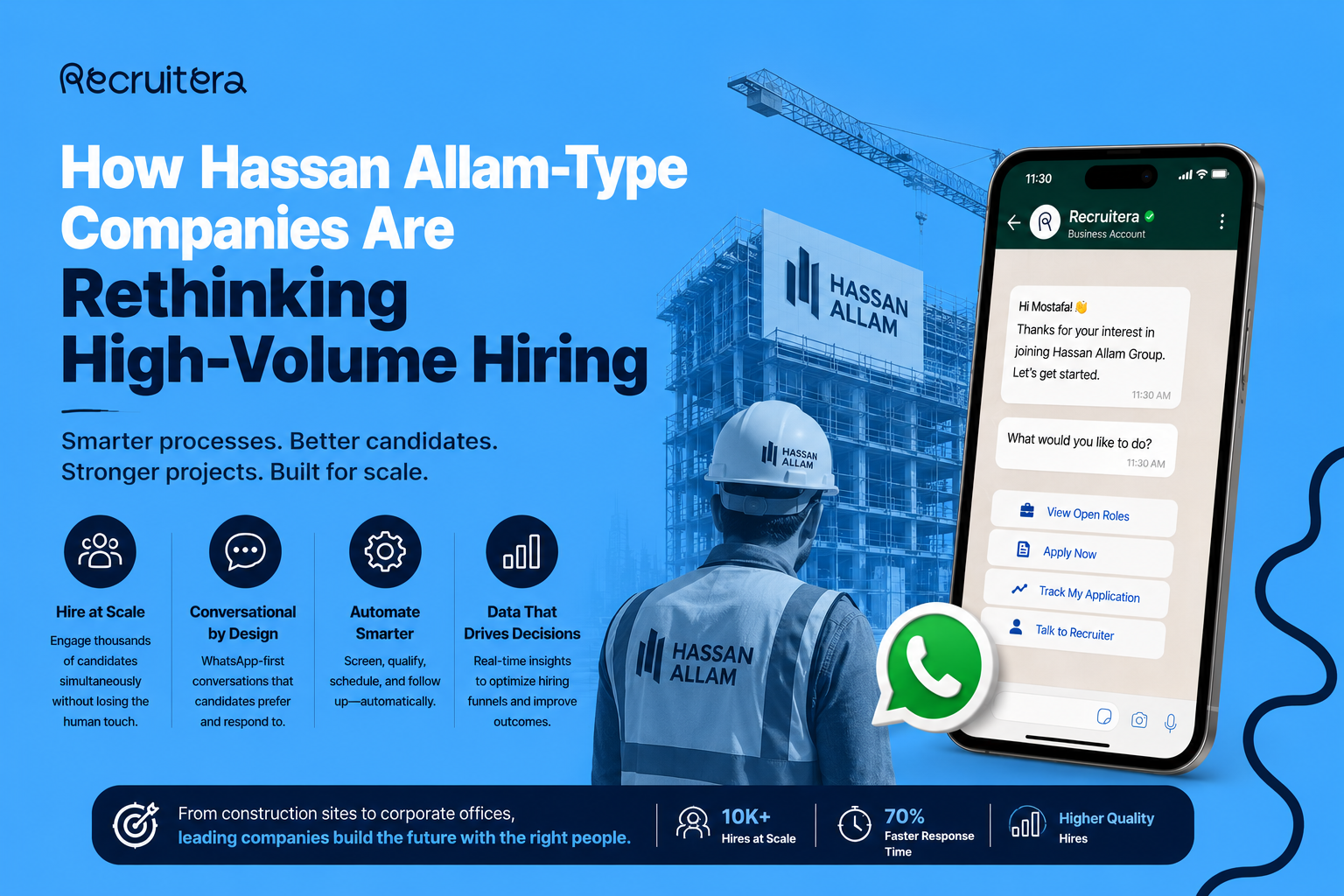
The most forward-thinking enterprise HR teams in Egypt are making a specific shift — formalizing the channel that actually works rather than continuing to mandate the use of channels that do not. This is a recognition that WhatsApp Hiring is already the primary channel for blue collar roles at many of these companies — it is just an unmanaged, untracked version of WhatsApp. The shift is to manage it. What this looks like in practice is connecting a company-owned WhatsApp number to the ATS — so that conversations that were already happening on WhatsApp now happen on a company number, are logged in the system of record, and are visible to the entire team.
What Changes Operationally
Speed. The automated bot handles first-touch for every inbound candidate immediately — 24 hours a day, 7 days a week.
Data visibility. For the first time, the informal channel becomes a tracked sourcing channel. HR leadership can see how many candidates entered the pipeline via WhatsApp and how their hire rate compares to candidates from other sources.
Compliance. When candidate communications happen on a company number connected to an ATS, every conversation is stored in a controlled environment with appropriate access permissions. The audit trail exists.
Resilience. When a recruiter leaves, the candidate relationships they managed remain in the system. The conversations are accessible to the team.
Scale. Bulk send allows enterprise HR teams to reach their entire talent pool with a single message when new roles open.
The Talent Pool as Strategic Asset
Every candidate who enters the pipeline via WhatsApp — screened, logged, and recorded in the ATS — becomes a permanent asset. The company that systematically builds this talent pool over time has a structural hiring advantage that compounds. When seasonal demand spikes or a production line needs to double its workforce in thirty days, the company with the talent pool can activate it immediately. The company without it starts from scratch.
Frequently Asked Questions
How do large enterprises manage WhatsApp hiring across multiple recruiters?
When WhatsApp is connected to an ATS via META's Business API, all recruiters access candidate conversations through the ATS platform rather than through a personal device. Any recruiter with appropriate permissions can view, take over, and manage any conversation. This makes WhatsApp a team tool rather than an individual tool — eliminating the recruiter dependency that makes personal phone-based hiring fragile at enterprise scale.
Can WhatsApp Hiring handle the volume of a large enterprise?
Yes. The automated bot handles first-touch for every inbound candidate simultaneously — there is no per-conversation limit. Bulk send allows enterprises to reach thousands of candidates in their talent pool with a single action. The WhatsApp Business API is designed for enterprise-scale messaging volumes.
What governance and compliance requirements does WhatsApp Hiring satisfy for enterprise clients?
All candidate conversations are stored in the ATS — a controlled environment with role-based access permissions and a full audit trail. The company owns the WhatsApp number and the data under its own META Business Portfolio. No candidate data lives on personal devices outside organizational control.
Further Reading
Also read: Blue Collar Talent Is on WhatsApp. Is Your ATS? and 5 Roles Where WhatsApp Outperforms Email for Recruiting.
Conclusion
The enterprise hiring challenge in Egypt is not a technology problem. It is a channel problem. The largest companies in Egypt's industrial economy are beginning to recognize that WhatsApp is not an informal workaround to be tolerated. It is the primary hiring channel for the candidate segment they need most — and it deserves the same infrastructure, governance, and integration that every other enterprise hiring channel receives.
Huda Khaled is a Product Marketing professional at Recruitera, a MENA-focused applicant tracking system built by Basharsoft Group.
Ready to Hire Smarter?
Recruitera helps you see the person behind the resume. Book a quick demo and discover a better way to build your team.
Book a Demo


Recruiters' first go-to knowledge hub.
Visit resources →Practical guides on sourcing, interviewing and employer branding in MENA.
Read the blog →Job descriptions, offer letters, interview scorecards and onboarding checklists, ready to copy.
Browse templates →New features, improvements and release notes from the Recruitera team.
See what's new →