
If you're hiring for even two or three roles at once, you already know the chaos: resumes in your inbox, candidate notes in a spreadsheet, feedback scattered across WhatsApp and email threads, and a hiring manager asking "where are we with that candidate?" for the fifth time this week.
An applicant tracking system exists to fix exactly that. It's not a digital filing cabinet for CVs. A modern ATS is the operating system behind your entire hiring process, connecting sourcing, screening, collaboration, and reporting in one place. But "connects everything" is vague until you see what actually happens at each stage.
Here's what an ATS actually does stage by stage, where the workflow tends to break down, and what to check before you trust a platform with it, especially if you're hiring in Egypt or the wider MENA market, where the tooling needs to fit local realities like multiple regional job boards and high applicant volume per role.
The ATS Hiring Workflow at a Glance
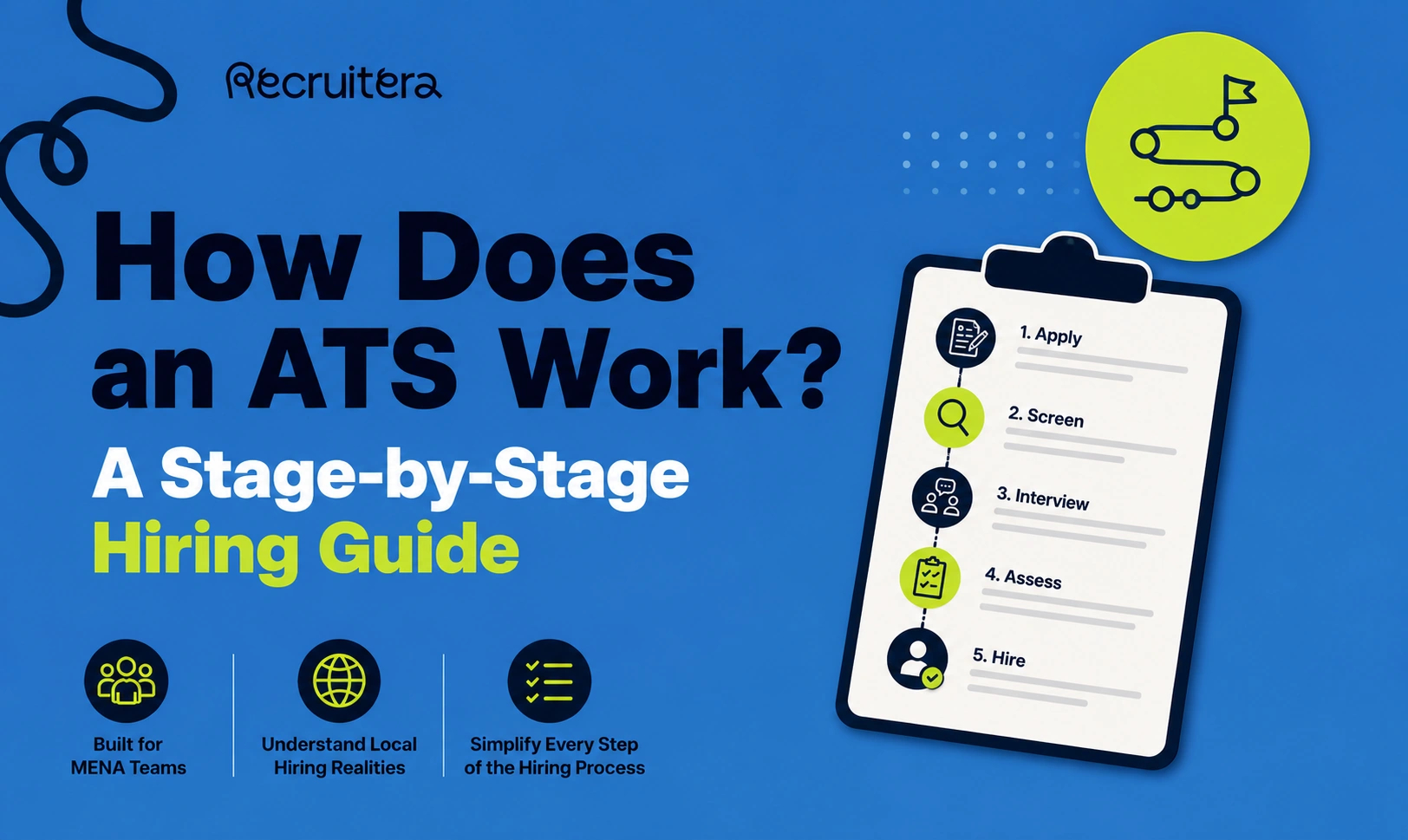
Every applicant tracking system, regardless of vendor, is built around the same underlying sequence:
Job opening → Sourcing → Application → Screening → Interviews → Evaluation → Offer → Hire
What separates a good ATS from a mediocre one isn't whether it covers these stages. It's whether the handoff between each stage is automatic or manual, and whether the whole hiring team can see the same picture at the same time.
How Each Stage Actually Works
1. Create and publish the job
Recruiters build the job opening inside the ATS: title, description, requirements, location, hiring team. From there, a good platform lets you publish across multiple job boards and career pages without recreating the same post four times.
For hiring teams in Egypt and MENA, this matters more than it might elsewhere. It's common to post across several channels at once, your own career page, regional boards, and LinkedIn, to reach enough qualified applicants. An ATS that handles multi-channel distribution from one job entry saves real hours per role, not minutes.
2. Source and collect candidates
Candidates arrive from job boards, career pages, referrals, and direct sourcing. Instead of that pool living in five different places, the ATS centralizes it into a searchable database, so a strong candidate you couldn't place last quarter is one search away when the right role opens.
3. Organize and screen applications
As applications land, the ATS structures them. Resume parsing turns unstructured CVs into searchable, comparable candidate data, skills, experience, and education, instead of raw PDFs recruiters have to open one by one.
Some platforms go further with AI-assisted screening and candidate matching, surfacing the applicants most likely to fit a role instead of leaving recruiters to skim hundreds of resumes manually. This is worth scrutinizing when you evaluate a platform: ask exactly how the matching works, not just whether the feature exists on paper.
4. Move candidates through the hiring pipeline
This is where an ATS earns its keep day to day. Instead of tracking status in a spreadsheet, candidates move through defined stages:
New Application → Screening → Interview → Assessment → Final Interview → Offer → Hired
A clear pipeline view makes bottlenecks visible immediately. If a dozen candidates are stuck at "Interview" for over a week, that's not a mystery buried in someone's inbox. It's a stage the whole hiring team can see and act on.
5. Automate repetitive recruitment tasks
Recruiting involves a lot of work that isn't actually recruiting: sending status updates, scheduling interviews, chasing follow-ups, acknowledging applications. A good ATS automates this layer, so recruiters spend their time on judgment calls, not admin. Automation commonly covers candidate emails and notifications, interview scheduling and reminders, candidate status updates, workflow triggers between stages, follow-up communications, and application acknowledgements. The goal isn't to remove humans from hiring. It's to remove the busy work around humans.
6. Collaborate with hiring managers
Hiring is rarely a solo act. Recruiters, hiring managers, department heads, and interviewers all need visibility into the same candidate, and an ATS gives them a shared space to leave feedback, add notes, and track decisions, instead of forwarding email chains back and forth.
7. Measure and improve the hiring process
An ATS also turns hiring activity into data you can act on: time to hire, applicant volume, candidate source performance, stage-to-stage conversion, interview-to-offer ratio, and offer acceptance rate. This is where recruiting stops being guesswork. If a particular sourcing channel converts twice as well as another, or candidates consistently drop off at the same stage, that's a pattern you can only see with reporting, not by remembering how last quarter felt.
Where This Workflow Actually Breaks Down
Most hiring delays don't come from a single dramatic failure. They come from small gaps between stages that compound, and the cost of letting them compound is higher than most teams assume:
Those figures only cover direct recruiting spend. They don't include the weeks a role sits open, the hiring manager hours lost to interviews and coordination, or the productivity hit of backfilling a bad hire, which is exactly why the gaps below are worth closing rather than tolerating. See the full breakdown in SHRM's 2025 cost-per-hire data.
The handoff between sourcing and screening stalls. Candidates pile up in an inbox faster than anyone can review them, and by the time a recruiter gets to a strong applicant, they've already accepted another offer.
Pipeline stages exist on paper but aren't tracked in practice. A "stuck at Interview for two weeks" candidate should be a visible flag, not something a hiring manager discovers by asking around.
Automation gets skipped, so recruiters do the admin manually. Every status update sent by hand is time not spent on the screening and judgment calls that actually need a person.
Nobody looks at the reporting until it's too late. A sourcing channel that's quietly underperforming, or a stage where candidates consistently drop off, stays invisible without regular reporting checks, not just a dashboard nobody opens.
Egypt and the Gulf: Where the Workflow Needs to Flex
A workflow built for the US or Europe assumes English-only postings, a handful of major job boards, and relatively low applicant volume per role. That assumption breaks quickly in Egypt and the Gulf, where hiring teams routinely post across several regional boards at once and screen far higher applicant volumes per opening.
There's also a compliance layer that's easy to miss. Hiring teams in Egypt now operate under the Personal Data Protection Law (Law 151/2020), and candidate data, CVs, contact details, and interview notes fall squarely under it. It's worth confirming how a platform handles data residency and access controls before you commit to it, not after you've already migrated your candidate database.
How Recruitera Runs This Workflow for MENA Teams
Most of what's described above is table stakes for any ATS. The real difference shows up in how connected the experience is and how well it fits the market you're actually hiring in.
Recruitera is built as an applicant tracking system for the Egypt and MENA hiring market specifically. Multi-channel job distribution is built around the platforms regional recruiters actually use, so one job posting reaches candidates without manual re-posting across boards. AI-assisted candidate screening and matching means recruiters facing hundreds of applications per role aren't manually opening every CV to find the handful worth a call. Smart, fair candidate distribution splits candidates across recruiters working the same role, avoiding duplicate outreach and uneven workload when multiple people are hiring for one position. A clear, visual candidate pipeline gives recruiters and hiring managers the same real-time view of where every candidate stands, and built-in automation for scheduling, status updates, and candidate communication means recruiters spend time on people, not process. Reporting covers the metrics that matter locally: time to hire, source performance, and pipeline conversion, so hiring decisions are based on data, not gut feel.
Instead of treating sourcing, screening, collaboration, and automation as separate tools bolted together, Recruitera brings them into one workflow built for how hiring teams in this region actually operate. If you're still deciding whether an ATS is worth adopting in the first place, our Applicant Tracking System: Everything You Need to Know guide covers the fundamentals and the cost side of that decision.
Questions to Ask Before You Trust a Platform With Your Workflow
Start with your process, not a feature checklist. Before evaluating platforms, ask:
- How many roles do we typically hire for at once?
- Where do our candidates actually come from?
- How much of our process is still manual today?
- How many people need to collaborate on each hiring decision?
- Which tools and job boards need to integrate with the ATS?
- What recruitment metrics do we actually need to track?
- Can the platform adapt to how we already work, or does it force us to change?
- How does the platform handle candidate data, where is it stored, and what does that mean for compliance in our market?
The best ATS isn't the one with the longest feature list. It's the one that fits the workflow you actually run, without adding complexity you don't need. For a closer look at how Recruitera compares to other platforms available in the region, see our Best ATS for MENA & Egypt: 2026 Buyer's Guide.
Frequently Asked Questions
How much does a bad hire actually cost?
Estimates vary by role and source, but the U.S. Department of Labor puts the baseline at roughly 30% of an employee's first-year salary. SHRM's 2025 Benchmarking Report shows direct cost-per-hire alone averaging $5,475 for non-executive roles and $35,879 for executive roles, and neither figure includes lost productivity while the role stays open.
What recruitment metrics should a hiring team track first?
Start with three groups: speed metrics like time to hire and time per stage, quality metrics like source of hire and offer-acceptance rate, and cost metrics like cost per hire and cost per channel. Tracking only one group tends to create blind spots, like cutting time to hire by skipping screening steps that protect quality.
How does ATS reporting turn hiring data into better decisions?
Reporting turns hiring activity into patterns you can act on: which sourcing channel converts best, where candidates consistently drop off, and how long each stage takes. Without it, you're relying on how last quarter "felt" instead of what the data actually shows.
Key Takeaways
An ATS isn't one feature, it's a connected sequence: job creation, sourcing, screening, pipeline movement, automation, collaboration, and reporting, each stage feeding the next. Most hiring delays come from gaps between these stages rather than a single broken step, and those gaps carry a real, documented cost: a baseline of 30% of first-year salary per bad hire, and thousands more in direct recruiting spend per SHRM's 2025 data. For teams hiring in Egypt and the Gulf, the workflow also needs to flex around regional job boards, higher applicant volume, and PDPL compliance. The right platform doesn't just cover every stage on paper. It makes the handoff between them close to invisible.