How to Run an Employee Referral Program Your Team Will Actually Use
Learn how to set up an employee referral program your team will actually use: which roles to open, bonus rules, tracking, and the numbers to watch.
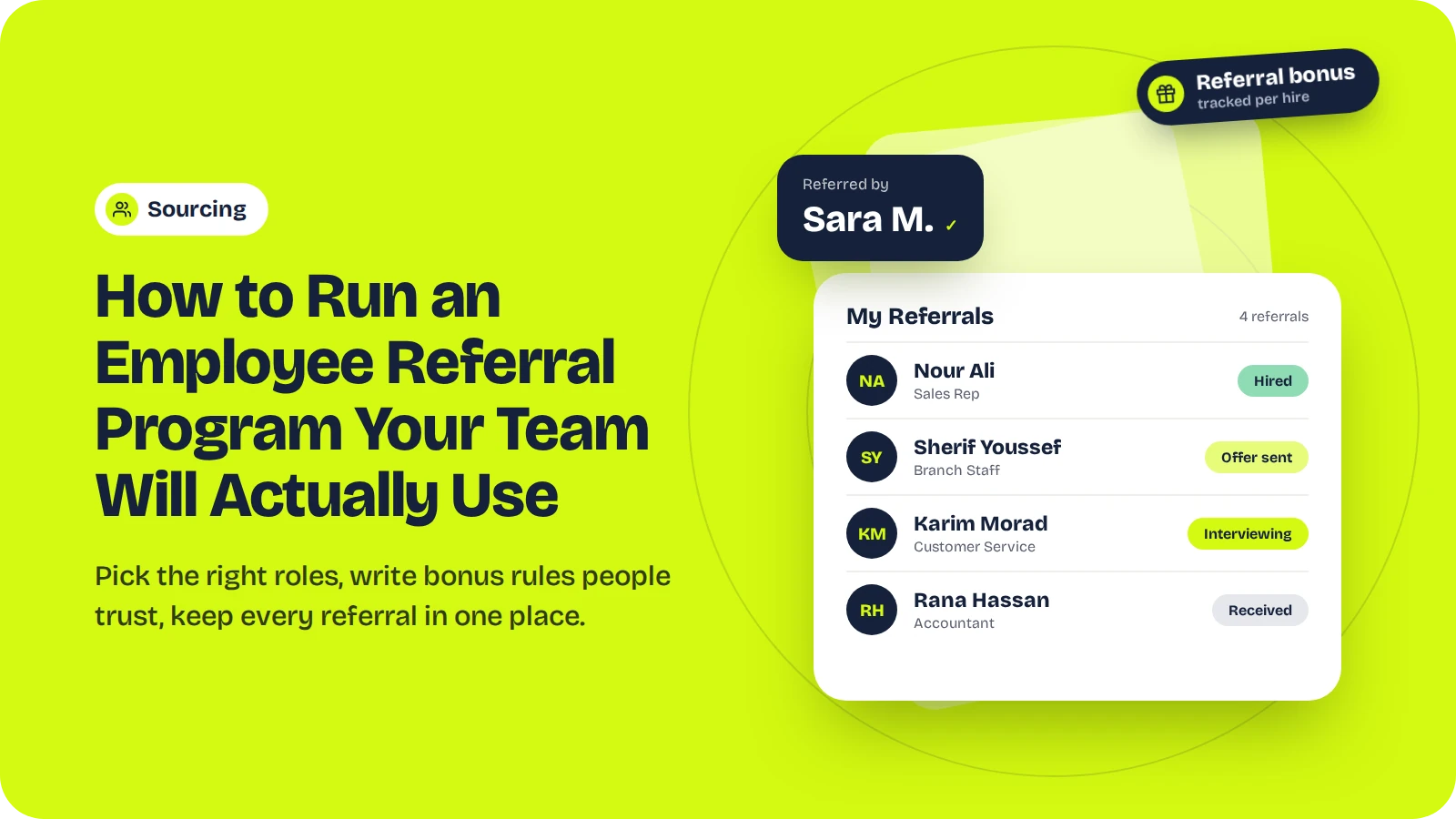

In short: Most SME referral programs start with a launch email and end in a WhatsApp group nobody checks. Here is how to set one up that people actually use: pick the right roles, write bonus rules everyone trusts, keep every referral in one place, and check a few numbers each quarter.
Ask most HR managers in Egypt where their best hires came from and you will hear a familiar answer: someone on the team knew them. An employee referral program turns that habit into a hiring channel you can plan around. The problem is that most programs at small and mid-sized companies never get past the announcement. CVs arrive as forwarded PDFs on WhatsApp, nobody remembers who sent what, and the referral bonus becomes an awkward conversation three months later.
This guide is for HR teams at Egyptian SMEs who want something simpler. It covers why referrals work, why most programs stall, and a step-by-step setup you can finish this month, from choosing roles to tracking bonuses and measuring results.
What is an employee referral program?
An employee referral program is a set of rules and tools that lets your employees recommend people they know for open roles. It defines who can refer, which jobs are open, how each referral is recorded, and what the referrer earns if the hire works out. That structure is what turns occasional favours into a channel you can measure.
Why employee referrals work
Referrals come with a filter built in. An employee who recommends a friend already knows the job, the manager and the culture, and they are putting their own name on the line. That usually means fewer mismatched candidates and shorter interview loops.
The strongest evidence is on retention. A study by EmployeeReferrals.com, published by iCIMS, covered more than 50 companies and 91,000 employees. Half of referral hires stayed at least 38 months, compared with 22 months for hires from other sources. At high-turnover companies, referral hires stayed 122% longer. For SMEs in retail, call centres or field sales, where churn is a constant cost, that matters more than any saving on time to hire.
There is a local angle too. Hiring in Egypt already runs on personal networks. A formal program puts that network to work in the open: every referred candidate goes through the same screening and interviews as everyone else, the referral is on record, and the reward follows written rules.
Why most SME referral programs fail
Having a program and having one that works are different things. In a 2017 SHRM article, recruitment consultancy HireClix reported that about 71% of companies had a referral program, yet 75% of those said it was not meeting its goals. The same piece lists the usual reasons employees don't refer: they don't know how, the process is slow or confusing, and nobody recognises the effort.
At SMEs, those problems usually look like this:
- Referrals live in chats and inboxes. A CV forwarded on WhatsApp has no record, no status and no proof of who sent it first. When two people refer the same candidate, HR has to guess.
- Employees don't know what is open. If the vacancy list sits in HR's head or on a job board, people refer for roles that were filled last month.
- Bonus rules are vague. "We'll reward good referrals" leads to disputes. When is the bonus paid? What if the hire leaves in week six?
- Referrers never hear back. If an employee can't answer their friend's "any news?", they stop referring.
- HR runs it alone. Without managers mentioning it in team meetings, the program fades after the launch email.
Most of these fixes are about structure, and they cost very little.
How to set up an employee referral program, step by step
Step 1: Decide what the program is for
Pick one or two goals first. Most SMEs want to fill recurring roles faster, cut agency or job ad spend, or improve retention in high-churn teams. Your goal decides which roles you open and which numbers you track later.
Step 2: Choose which roles to open
You don't need to open every vacancy. Start with three to five roles where referrals have the best chance of working:
- Recurring roles you hire for every month, such as sales reps, customer service agents or branch staff. Employees often know several people doing the same job elsewhere.
- Hard-to-fill roles where job ads bring volume but not quality, like experienced accountants or developers.
- Roles where fit matters most, such as small teams that work closely together.
Keep some roles out. Confidential replacements, roles you plan to fill through internal hiring first, and senior positions with their own approval process are better handled separately. When a role is filled, close it the same day so nobody refers for a job that no longer exists.
Internal hiring belongs in the same conversation. When employees can apply for open roles themselves, before or alongside external referrals, they see that growth inside the company is real. You also keep good people who might otherwise leave for a promotion somewhere else.
Step 3: Set referral bonus rules people trust
Bonus disputes end programs faster than anything else, so write the rules down before launch. A simple policy covers five points:
- Amount. Use a fixed amount per role level rather than a percentage of salary. It is easier to explain and keeps salaries confidential. Hard-to-fill roles can carry a higher amount.
- Timing. Pay after the new hire passes probation, or split it between the start date and the 90-day mark. SHRM suggests adding a 90- or 120-day retention payment on top of a start bonus, so referrers stay focused on quality.
- Eligibility. Decide whether HR staff and hiring managers can earn bonuses for their own roles (most companies say no), and whether the referrer must still be employed on the payout date.
- Duplicates. The first referral on record wins. Candidates already in your pipeline in the last six months don't count.
- Non-cash rewards. An extra day off, a team lunch or public thanks in the monthly meeting work well alongside cash.
Referral bonus tracking is where spreadsheets break down. Someone has to remember the start date, check probation and confirm the referrer is still employed months later. Whatever tool you use, the record of who referred whom, and when, should be created at the moment of referral, not typed in later.
Step 4: Give employees one place to refer
Employees should be able to see open roles and submit a referral in a couple of minutes, from their phone. That means one portal or link, not "send the CV to HR on WhatsApp". The two common options are a form the employee fills in for the candidate, and a personal referral link the candidate uses to apply directly. Offer both if you can.
Step 5: Keep referrers in the loop
A simple status is enough: received, interviewing, offered, hired or not selected. If a candidate is rejected, the employee hears it from you first rather than from an annoyed friend. This one habit does more to keep people referring than a bigger bonus.
Step 6: Launch, then keep it visible
Announce the program with the policy, the open roles and the link. Then keep it alive. Ask managers to mention open roles in team meetings, share new referral jobs every month, and announce each successful hire and payout with the employee's permission. A single launch email is rarely enough.
Running your employee referral program in Recruitera
If you already use Recruitera as your ATS, the referral program runs from the Employee Hub, so there is no separate employee referral software to buy or maintain.
- Employees browse open jobs in the hub and can apply internally for roles they want for themselves.
- They refer in two ways: by filling in the application on the candidate's behalf, or by sharing a referral link the candidate uses to apply.
- Every referred application is tagged "Referred by [employee name]", so recruiters see the source right in the pipeline.
- Employees follow progress in My Referrals, which answers "what happened to my friend?" without a message to HR.
- Admins can turn on bonus and rewards tracking, so payouts sit with the referral record instead of in a separate sheet.
- Recruiters choose which jobs appear in the hub, which turns Step 2 into a setting rather than a policy debate.
The setup steps are in our help articles. You can see how the Employee Hub fits with the rest of the platform on our website [WEBSITE SECTION LINK], and read the release details in Recruiters Updates.
How to measure your employee referral program
Review these numbers every quarter. Most come straight from your ATS when referrals are tagged at the source.
| Metric | How to calculate it | What it tells you |
|---|---|---|
| Participation rate | Employees who referred at least once ÷ total employees | Whether people know about the program and trust it |
| Referral share of hires | Referral hires ÷ total hires | How much of your hiring the program carries |
| Referral-to-hire rate | Referral hires ÷ referrals received | Whether you get quality or just volume |
| Time to hire | Average days from application to offer, referrals vs other sources | Whether referrals actually speed things up |
| 90-day and 12-month retention | Referral hires still employed ÷ referral hires | Whether the retention gain shows up in your company |
| Cost per referral hire | Bonuses and rewards paid ÷ referral hires | How the channel compares with ads and agencies |
Read the numbers together. High participation with a low hire rate usually means role requirements were unclear. A good hire rate with low participation means the program works but people have forgotten it exists. Also look at who is being referred. If every referral comes from the same department or university, open a wider mix of roles so your team doesn't end up looking the same.
Frequently asked questions
How much should a referral bonus be?
There is no standard figure. Set an amount you can pay for every successful hire, then compare it with what you spend today on job ads or an agency for the same role. Higher amounts for hard-to-fill roles are common.
Should hiring managers get referral bonuses?
Most companies exclude HR staff and the hiring manager for their own team, since they already decide on the hire. They can still refer for other departments.
What is the difference between a referral program and internal hiring?
Internal hiring fills a role with someone already on your team, through a transfer or promotion. A referral program brings in someone from outside on an employee's recommendation. Many companies open the same roles to both.
Do we need employee referral software?
For a handful of referrals a year, a shared form can work. Once referrals, bonuses and status updates start piling up, a tool that records the referrer automatically saves HR hours and prevents disputes.
Start your referral program this month
A referral program doesn't need a big budget. It needs clear roles, written bonus rules, one place to refer, and regular updates for the people who refer. Get those four right and your own team becomes one of your best sourcing channels.
Want to run it without spreadsheets or WhatsApp threads? See how Recruitera's Employee Hub works [WEBSITE SECTION LINK] and open your first referral jobs today.
Sources
- How employee referrals impact retention, iCIMS / EmployeeReferrals.com
- How to get more people to use your employee referral program, SHRM (2017)
- How to create an employee referral program, SHRM
Ready to Hire Smarter?
Recruitera helps you see the person behind the resume. Book a quick demo and discover a better way to build your team.
Book a Demo
Recruiters' first go-to knowledge hub.
Visit resources →Practical guides on sourcing, interviewing and employer branding in MENA.
Read the blog →Job descriptions, offer letters, interview scorecards and onboarding checklists, ready to copy.
Browse templates →New features, improvements and release notes from the Recruitera team.
See what's new →