Why a Searchable Candidate Database Beats Spreadsheets and Email Threads
Why a searchable candidate database beats spreadsheets, on Recruitera, the AI-powered ATS that helps MENA teams source and automate hiring. Book a Demo!
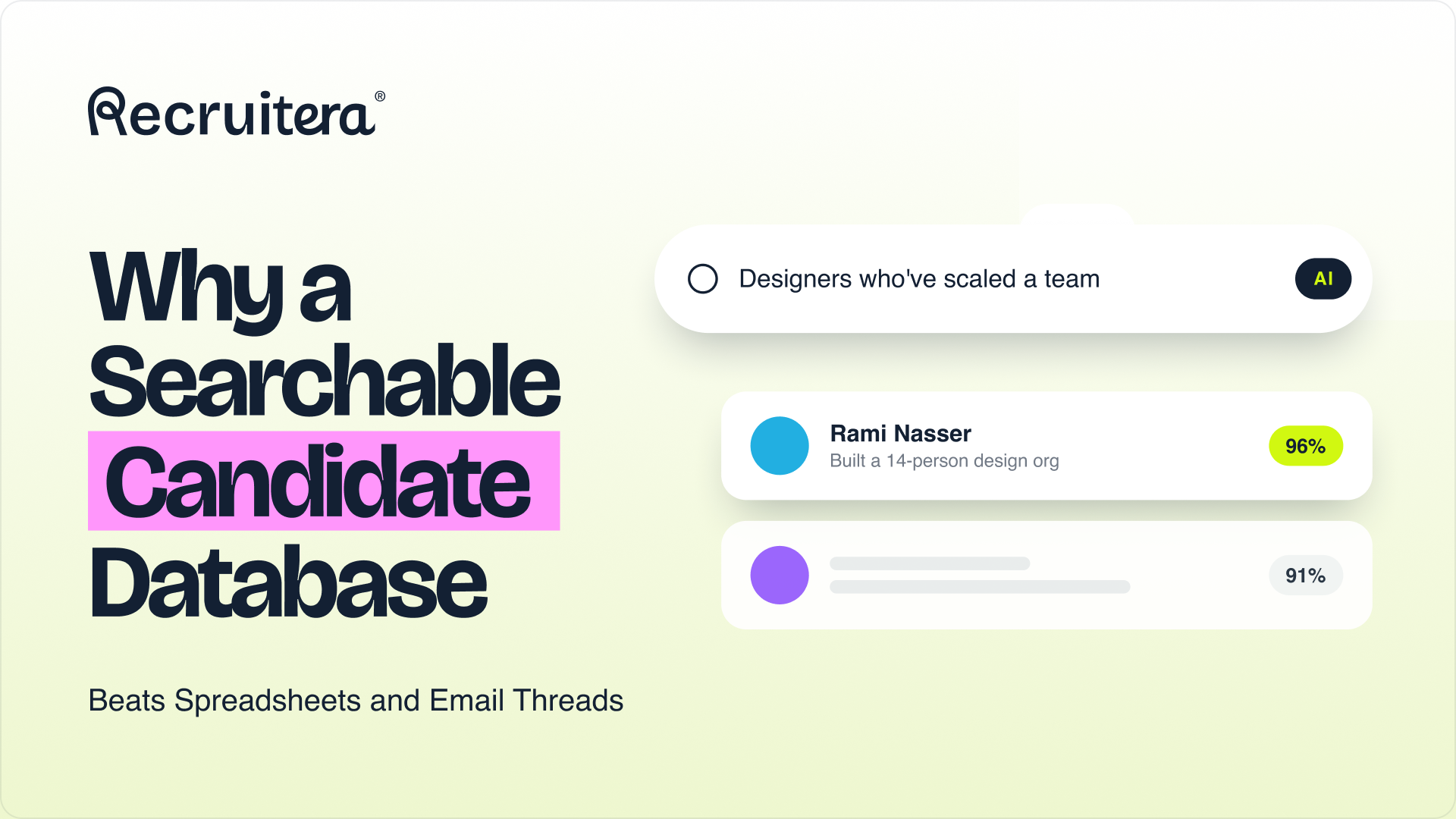

A recruiter remembers interviewing a strong candidate for a similar role about six months ago. She'd be perfect for the opening you just posted.
But where is her CV? Was it in the shared drive, an old email thread, or that spreadsheet Ahmed kept before he left the team? You end up asking around, searching subject lines, and opening three different files before giving up and posting the job again.
The issue was never a lack of candidate data. It's that finding and using it takes longer than starting from zero. As hiring activity grows, spreadsheets and email threads stop being a system and start being a scavenger hunt.
Why Spreadsheets and Email Threads Stop Working as Hiring Scales
Spreadsheets and inboxes work fine when one person is hiring for one role. The trouble starts once a team grows.
Every recruiter tends to keep their own version. One person's sheet has a "shortlisted" tab, another's has "interviewed," and nobody agrees on what "in progress" means. Candidates get duplicated across files. Information goes stale the moment someone forgets to update a row.
Interview feedback lives in someone's inbox, not attached to the candidate's profile. A hiring manager who wants to check where things stand has to ask a recruiter instead of just looking it up. And when a similar role opens six months later, nobody remembers who applied the first time, so sourcing starts over from scratch.
None of this means spreadsheets or email are bad tools. They just weren't built to be a shared, searchable record of everyone your team has ever talked to. They're built for lists, not for recall.
What Is a Searchable Candidate Database?
A searchable candidate database is a centralized system where candidate profiles and recruitment data can be stored and pulled up based on specific criteria, not just scrolled through row by row.
Depending on the platform, that can include things like skills, experience, previous applications, job applied for, candidate status, location, tags, or recruitment stage.
There's a real difference between storing candidate information and being able to find and act on it. A spreadsheet stores information too. What it usually can't do is let you type "customer service, 2+ years, Cairo" and get a shortlist back in seconds. That gap, between having data and being able to use it, is the whole point of this article.
If you're still mapping out what an ATS actually does beyond storage, our guide on what an applicant tracking system is and how it works breaks it down in more detail.
Searchable Candidate Database vs. Spreadsheet
| Spreadsheet-Based Candidate Management | Searchable Candidate Database |
|---|---|
| Candidate data spread across multiple files | Centralized candidate information |
| Searching requires manual filtering | Search and filters built around candidate data |
| Different teams keep separate versions | Shared, single source of recruitment data |
| Updates are inconsistent across copies | Records maintained in one place |
| Reusing old candidates is hard | Previous candidates can be revisited easily |
| Limited context beyond the CV itself | Candidate data connected to the full hiring process |
Why Searchability Changes the Way Recruiters Hire
Find Existing Candidates Before Starting From Scratch
Say a company needs a customer service representative. Instead of posting the job and waiting, the recruiter can first check whether qualified people from past applications are already sitting in the database. If a few are, outreach can start the same day.
Reduce Repetitive Sourcing Work
Recruiters often end up sourcing candidates they've already encountered once before, just without realizing it. A searchable database won't do the outreach for you, but it makes it far easier to check who you've already found before spending hours looking for them again.
Keep Candidate History in Context
A CV alone doesn't tell you much. What matters is the surrounding context: which stage a candidate reached, what feedback came out of the interview, how they communicated. When that history is attached to the profile instead of buried in an inbox, reconsidering someone for a different role takes minutes instead of a group chat asking "does anyone remember this person?"
Make Recruitment Knowledge Accessible to the Team
If candidate information lives in one recruiter's inbox, the whole team depends on that one person being available. A centralized database means anyone authorized can pick up a candidate's history mid-process, which matters a lot during handovers or when someone's out.
A Searchable Candidate Database Turns Past Applicants Into a Future Talent Pool
Not getting hired for one role doesn't make a candidate irrelevant. They might have been a strong fit but lost out to someone slightly stronger. They might have applied for the wrong role but been perfect for a different one. They might have been too junior at the time and are exactly right now.
None of that potential is worth much if you can't find these people again. Searchable candidate data is what makes rediscovering them realistic instead of accidental. We go deeper into how to build this intentionally in our guide to building talent pools in Egypt and how it shortens hiring the next time a similar role opens.
SHRM has covered this too: recruiters often overlook "silver medalist" candidates, people who made it to the final rounds of a past process but weren't selected, even though they've already been vetted and are often ready to be re-engaged when the right role comes up again.
When Should Recruiters Move Beyond Spreadsheets?
Not every small team needs a full ATS on day one. But a few signs suggest you've outgrown spreadsheets:
- Multiple recruiters are managing candidates separately
- You're hiring for several roles at once
- The same candidates keep showing up in different files
- People keep asking each other for old CVs
- Past applicants are rarely reconsidered for new openings
- Hiring managers can't see candidate history without asking someone
- Your team spends more time organizing data than using it
If most of this sounds familiar, especially for teams handling high volume roles like customer service, sales, or seasonal hiring across Egypt and MENA, it's worth looking at how a structured system can reduce time-to-hire rather than adding another tab to the sheet.
How Recruitera Helps Make Candidate Data More Searchable and Usable
Recruitera is built to help hiring teams manage candidate information as part of the actual workflow, not as a side task done in spreadsheets after the fact. That means centralized candidate profiles, search and filtering across your existing applicant pool, and the ability to track candidates through recruitment stages without losing history along the way.
It also means past candidates stay part of your pipeline instead of disappearing once a role closes, so building a talent pool becomes something that happens naturally as you hire, not a separate project.
Recruitera doesn't replace every email or every spreadsheet your team uses. What it does is give your candidate data a place to live where it can actually be found again.
The Real Value Isn't Storage
Spreadsheets store candidate information. A searchable candidate database helps you use it. The recruiter who remembers a great candidate from six months ago shouldn't have to dig through five files to find her. She should be one search away.
When candidate data is centralized, searchable, and connected to your hiring process, yesterday's applicants become tomorrow's shortlist. If your team is ready to stop losing good candidates to disconnected files, see how Recruitera organizes your candidate data so it works for you the next time a role opens.
Ready to Hire Smarter?
Recruitera helps you see the person behind the resume. Book a quick demo and discover a better way to build your team.
Book a Demo

Recruiters' first go-to knowledge hub.
Visit resources →Practical guides on sourcing, interviewing and employer branding in MENA.
Read the blog →Job descriptions, offer letters, interview scorecards and onboarding checklists, ready to copy.
Browse templates →New features, improvements and release notes from the Recruitera team.
See what's new →