Why Blue Collar Hiring in Egypt Is Broken — And What WhatsApp Can Fix
Why Blue Collar Hiring in Egypt Is Broken — And What WhatsApp Can Fix

Introduction
There is a moment every HR manager at a manufacturing company in Egypt knows well. A job opens — operator, technician, driver, line worker. The job goes up on the company's career page. Maybe it goes up on a job board. And then the waiting begins.
The applications that do come in are often the wrong fit. The candidates who would be a perfect fit never see the listing. And somewhere in the office, a recruiter is typing a candidate's name into WhatsApp from their personal phone, hoping they pick up.
This is not a technology problem. It is not a sourcing problem. It is a channel problem — and it has been hiding in plain sight for years.
Blue collar hiring in Egypt is broken. Not because the talent isn't there. Not because companies aren't trying. But because the entire infrastructure of modern recruitment was built for a candidate who does not exist in this segment — a candidate who browses job boards, checks their email regularly, and submits a formatted CV through an online application form.
The blue collar worker in Egypt does not look like that. And the hiring process has not caught up.
The Profile Nobody Designed For
Egypt's blue collar workforce is enormous. Manufacturing, construction, logistics, food and beverage, retail — these sectors collectively employ millions of Egyptians, and they are hiring constantly. Turnover is high. Demand is relentless. The pressure on HR teams to fill roles quickly is unlike anything in white collar hiring.
And yet the tools available to those HR teams were designed for a completely different candidate profile.
Job boards assume candidates have reliable internet access, a computer or smartphone capable of running a web browser smoothly, and the literacy and motivation to fill out a multi-step online application. Applicant tracking systems assume candidates have email addresses they check regularly. Interview scheduling tools assume candidates will click a link in an email, open a calendar invite, and confirm their slot.
None of these assumptions hold for a significant portion of Egypt's blue collar workforce.
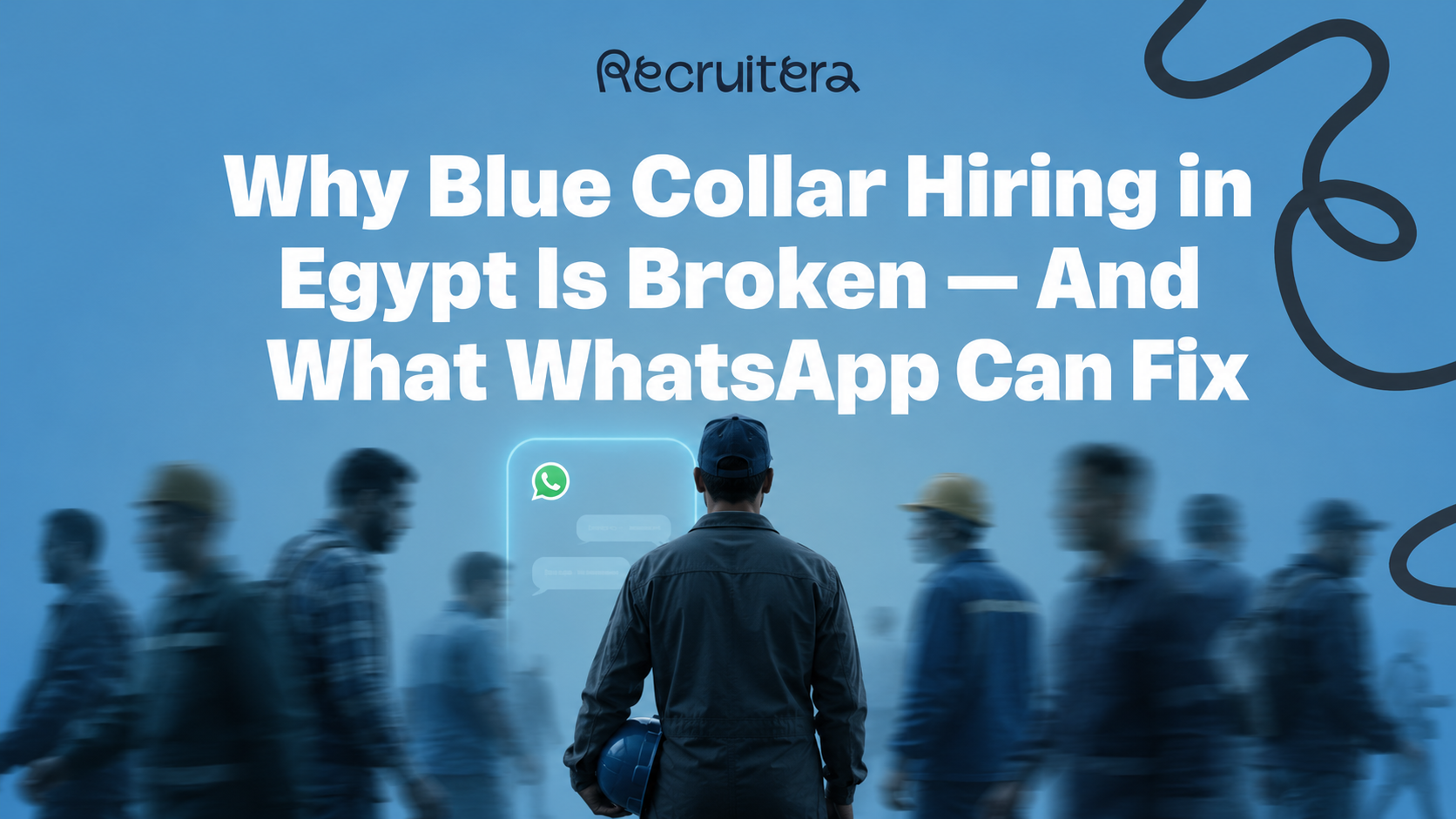
WhatsApp, however, does. According to Statista, WhatsApp penetration in Egypt is among the highest in the MENA region — the app is used by a significant majority of smartphone owners, cutting across income levels, education levels, and digital literacy levels. A factory worker who has never opened a job board in their life almost certainly has WhatsApp. They check it throughout the day. They respond to messages. They share voice notes. It is, for many, the primary way they communicate with the world beyond their immediate circle.
This is not a niche insight. Every recruiter who works in this segment already knows it. The gap is between knowing it and doing something about it systematically.
What Is Actually Happening Right Now
Walk into most HR departments at manufacturing or construction companies in Egypt and ask how they reach blue collar candidates. The answer is almost always some version of the same story.
Referrals. Word of mouth. Posters at the factory gate. A WhatsApp group where someone drops a job announcement. A recruiter messaging candidates directly from their personal phone, hoping the number still works, hoping the message gets seen.
This is not informal because HR teams are not trying. It is informal because the formal tools do not work for this candidate profile. Email open rates for blue collar candidates in Egypt are negligible. Online application completion rates are low. Job board visibility for hourly and manual roles is poor.
So recruiters do what works — they go to WhatsApp. But they do it without any infrastructure around it. No tracking. No audit trail. No way to know which candidates were contacted, which ones responded, which ones were qualified but fell through the cracks because the recruiter was sick that day or left the company.
When a recruiter who has been managing candidate relationships from their personal phone leaves the organization, they take every conversation with them. The company loses not just an employee but an entire network of candidate contacts — built over months or years, living on a device that is no longer in the building.
This is the broken system. It works just enough to keep companies hiring. But it does not scale. It does not track. And it breaks completely the moment the person running it is not there.
The Cost Nobody Is Calculating
The direct costs of blue collar hiring are visible — job board fees, recruiter time, onboarding costs. But the indirect costs of broken hiring infrastructure are rarely calculated, and they are significant.
Candidate drop-off is the most immediate one. When the application process requires steps a candidate cannot or will not complete — clicking a link, filling a form, attaching a CV — a significant percentage of potentially qualified candidates simply do not apply. They see the job announcement in a WhatsApp group, they are interested, and then they hit a friction point that was designed for someone else. They move on.
Recruiter dependency risk is less visible but equally costly. When hiring relationships live on personal devices, the company's ability to hire is dependent on specific individuals. This is a structural vulnerability that most organizations do not recognize until a key recruiter leaves and the pipeline collapses.
Time-to-fill inflation is perhaps the most measurable. When the application and screening process is manual — posting, waiting, following up individually via personal WhatsApp, scheduling interviews one by one — every step takes longer than it needs to. In high-volume blue collar hiring, this compounds quickly. A role that should take two weeks to fill takes six. Multiply that across dozens of open positions and the operational impact becomes significant.
What WhatsApp Actually Fixes
The argument for WhatsApp as a hiring channel for blue collar workers is not complicated. It is the channel they use. It works on basic smartphones. It does not require email. It does not require a formatted CV. It requires only that a candidate type a message — something they do dozens of times a day already.
What has been missing is not the channel. What has been missing is the infrastructure around it.
A recruiter messaging from a personal phone is using WhatsApp as a channel. But they are doing it without any of the things that make a hiring channel functional at scale — a consistent brand identity, a shared team inbox, a record of every conversation, automated first-touch handling, and integration with the rest of the hiring pipeline.
When WhatsApp is connected directly to an ATS via META's Business API, the picture changes entirely. The company gets a dedicated WhatsApp Business number — registered under the company name, managed by the entire team, integrated into the candidate pipeline. The automated bot handles first-touch — greeting candidates, asking screening questions, presenting interview slots, and confirming bookings — without any recruiter involvement. Every conversation is logged against the candidate record. Every stage of the process is visible in the same pipeline where every other sourcing channel lives.
The recruiter's personal phone is no longer in the picture. The informal process has been formalized. And the channel that was already working — just not properly — is now working properly.
The Specific Problems It Solves
Application friction eliminated. A candidate sees a job announcement on a WhatsApp group. They message the company number. The bot responds immediately, in Arabic, and begins the screening process. There is no link to click, no form to fill, no email to send. The application happens in the same place the candidate found the job.
Candidate drop-off reduced. Because the process meets candidates where they are and removes friction, more of the candidates who express interest complete the process. The drop-off point — the form, the email, the link — is gone.
Recruiter dependency eliminated. Because every conversation happens on a company number managed through an ATS, nothing lives on a personal device. A recruiter can leave tomorrow and every candidate relationship they built remains accessible to the team.
Scale becomes possible. Bulk send allows HR teams to reach hundreds of candidates in their talent pool with a single message — a job alert, a re-engagement message, an interview reminder. What previously required a recruiter to send individual messages one by one can now happen in one action.
Pipeline visibility restored. Because WhatsApp conversations are logged in the ATS alongside every other sourcing channel, HR managers can finally see what is happening across the full pipeline — which channels are producing qualified candidates, which are not, and where candidates are dropping off.
What This Means for Egypt's HR Teams
The companies that figure this out first will have a structural advantage in blue collar hiring that is difficult to replicate. Not because the technology is complicated — it is not — but because the candidate experience advantage compounds over time.
A candidate who had a smooth, fast, Arabic-language WhatsApp hiring experience with Company A is more likely to refer others to Company A. A company with a reputation for responding quickly and treating candidates well on WhatsApp will attract more inbound applications. And a company with a full pipeline of engaged candidates in their ATS talent pool — reachable instantly via bulk send — can fill roles faster than a company starting from scratch every time a position opens.
Blue collar hiring in Egypt is not broken because the talent is not there. It is broken because the channel gap between where companies post and where candidates actually are has never been properly closed.
WhatsApp closes that gap. And for the companies that move first, that is a significant competitive advantage in a market where speed to fill directly affects operational output.
Conclusion
The case for WhatsApp as a blue collar hiring channel is not a technology argument. It is a common sense argument. Your candidates are on WhatsApp. They check it constantly. They respond to it quickly. They understand it intuitively. Every recruiter in your organization already knows this — because they are already using it, informally, from their personal phones.
The question is not whether WhatsApp works for blue collar hiring. It clearly does. The question is whether it works within a system — with a company number, automated screening, full conversation tracking, and ATS integration — or whether it continues to work informally, invisibly, and at personal risk to every recruiter who carries those relationships on their personal device.
The infrastructure now exists to do it properly. The companies that adopt it first will hire faster, lose fewer candidates, and build talent pipelines that do not disappear when a recruiter moves on.
The rest will keep waiting for email responses that are never coming.
Frequently Asked Questions
Q1: Why don't blue collar candidates in Egypt respond to job board applications?
Blue collar candidates in Egypt largely don't use job boards — not because they aren't looking for work, but because job boards were designed for a different candidate profile. They require reliable internet access, digital literacy, a formatted CV, and the motivation to complete a multi-step application form. For a factory worker, driver, or construction laborer, none of these are a given. WhatsApp, by contrast, requires none of these things. It works on basic smartphones, it requires no CV, and it is already part of how these candidates communicate every day. The channel mismatch — not candidate disinterest — is why job board application rates for blue collar roles in Egypt are consistently low.
Q2: Is WhatsApp a professional channel for hiring — or does it seem unprofessional to candidates?
For blue collar candidates in Egypt, WhatsApp is not just professional — it is the expected channel. These candidates conduct most of their important communications via WhatsApp, including work-related ones. Receiving a job inquiry or interview confirmation via WhatsApp feels natural and trustworthy to them in a way that an email from an unfamiliar address does not. The professionalism question is actually the reverse — a company that reaches out on WhatsApp with a branded company number, a clear message, and a structured process comes across as organized and responsive. A company that sends an email nobody opens, or posts a job nobody applies to, comes across as out of touch.
Q3: How do blue collar candidates in Egypt typically find out about job openings?
The most common channels are referrals, WhatsApp groups, physical notices at factory gates or community centers, and word of mouth. Formal channels — job boards, career pages, email newsletters — play a very small role in how blue collar candidates in Egypt discover job opportunities. This is why companies that rely exclusively on formal digital channels consistently struggle to fill these roles at volume, while companies with strong referral networks and informal WhatsApp presence tend to hire faster. The implication for HR teams is clear — meeting candidates where they already are, rather than expecting them to come to where the company posts, is the more effective approach.
Q4: What is the biggest mistake companies make when hiring blue collar workers in Egypt?
The single biggest mistake is designing the hiring process for the wrong candidate. Companies build application flows, email sequences, and interview scheduling systems that work perfectly well for white collar candidates — and then apply them unchanged to blue collar hiring. The result is a process that creates friction at every step for a candidate who was never the intended user. The second most common mistake is allowing the informal WhatsApp hiring that naturally emerges in response to this problem to continue without any infrastructure — creating recruiter dependency, data loss, and pipeline fragility without anyone recognizing it as a systemic risk.
Q5: Can WhatsApp replace a job board entirely for blue collar hiring?
For many blue collar roles in Egypt, WhatsApp can handle the majority of the sourcing and screening process — but it works best as part of a multi-channel approach rather than a complete replacement. Job boards still serve a function for candidates who are actively searching and digitally comfortable. WhatsApp excels at reaching candidates who are not actively searching, capturing referral-driven applications, and handling the intake and screening process quickly once a candidate has expressed interest. The most effective blue collar hiring operations use WhatsApp as the primary communication and screening channel while maintaining visibility on other platforms for reach.
Q6: How do you maintain a candidate pipeline for blue collar roles without a job board?
The most effective approach combines three things — a WhatsApp channel for inbound applications and referral-driven candidates, a talent pool inside an ATS that is regularly updated with screened candidates, and a bulk send capability to re-engage that talent pool when new roles open. Companies that build this infrastructure hire significantly faster than those starting from scratch every time a role opens, because they have a pool of pre-screened, previously engaged candidates they can reach instantly via WhatsApp. The talent pool becomes a competitive asset — built over time, maintained inside the ATS, and reactivated on demand.
Ready to Hire Smarter?
Recruitera helps you see the person behind the resume. Book a quick demo and discover a better way to build your team.
Book a Demo

Recruiters' first go-to knowledge hub.
Visit resources →Practical guides on sourcing, interviewing and employer branding in MENA.
Read the blog →Job descriptions, offer letters, interview scorecards and onboarding checklists, ready to copy.
Browse templates →New features, improvements and release notes from the Recruitera team.
See what's new →