The Hidden Cost of Manual WhatsApp Hiring (And How to Fix It)
The Hidden Cost of Manual WhatsApp Hiring (And How to Fix It)
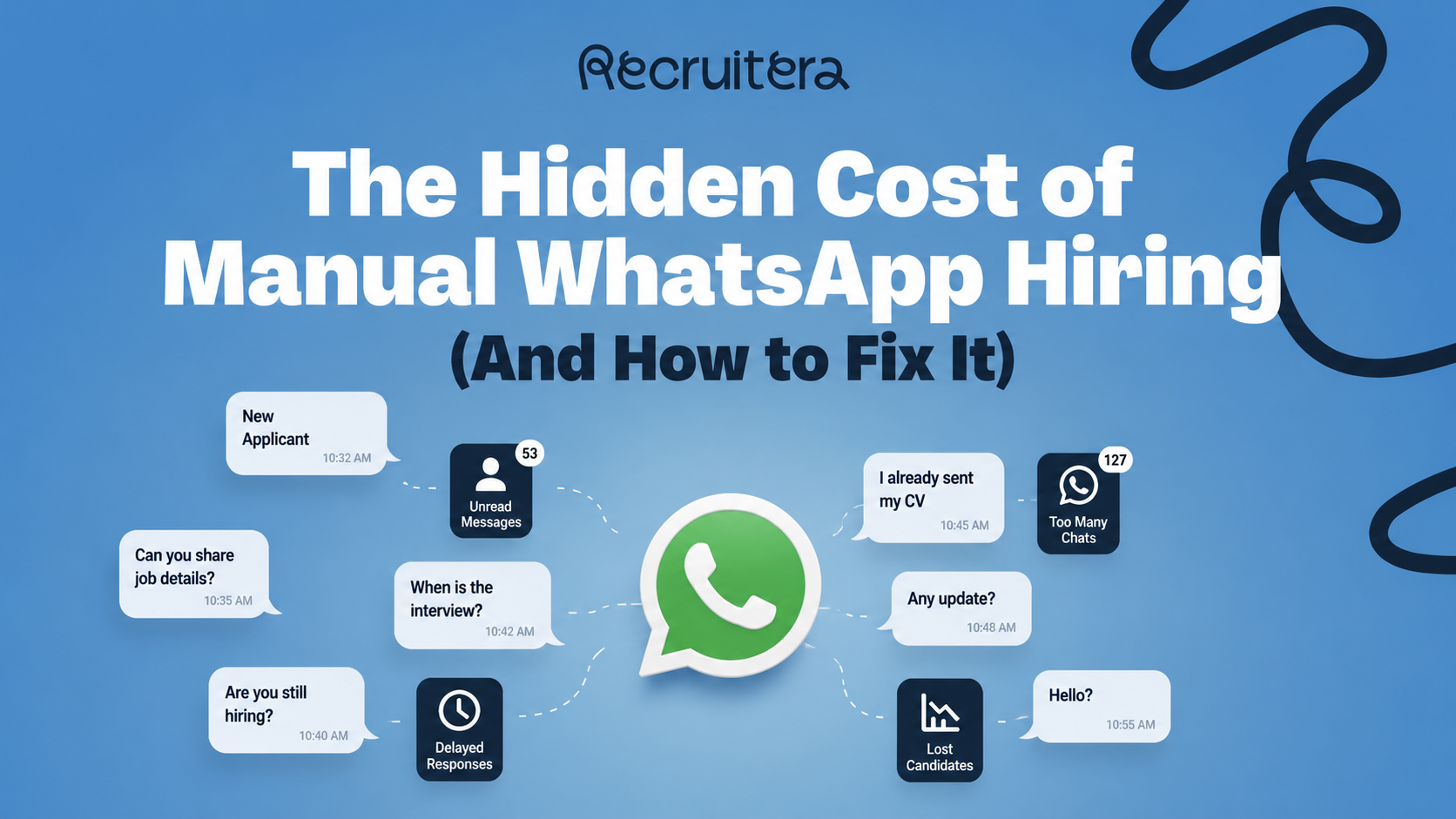

Introduction
Ask any HR manager at a mid-to-large company in Egypt how their recruiters communicate with candidates, and you will get one of two answers. The first is the official answer — email, the ATS, the career page. The second, usually offered after a pause, is the real answer — WhatsApp.
Not the company's WhatsApp. Not a managed, tracked, audited WhatsApp channel. A recruiter's personal WhatsApp. Sometimes several recruiters' personal WhatsApps. A loose, uncoordinated system of individual conversations happening across multiple personal devices, with no central record, no visibility, and no process holding it together beyond the individual recruiter's memory and availability.
This is manual WhatsApp hiring. It is happening at most companies in Egypt that hire at volume — and almost none of them have calculated what it is actually costing them.
The cost is not in the WhatsApp messages themselves. Those are free. The cost is in everything that breaks when hiring relationships live on personal devices — the candidates who fall through the cracks, the time wasted on repetitive manual tasks, the pipelines that collapse when a recruiter leaves, and the decisions made without data because no data was ever collected.
This article is about making that cost visible — and about what it looks like when the infrastructure around WhatsApp finally catches up to the channel itself.
The Invisible Infrastructure Problem
Every hiring channel has two components — the channel itself and the infrastructure around it. Email has an inbox, a sent folder, a search function, a record of every message. LinkedIn has an applicant tracking integration, a message history, a profile attached to every conversation. Your career page has an application form that feeds into a pipeline.
WhatsApp, used informally from a personal phone, has none of this. It has a chat. It has a contact. And it has whatever the recruiter remembers about the conversation the last time they opened it.
This is not a criticism of WhatsApp — it is a criticism of using a consumer tool for a professional process without any of the infrastructure that makes professional processes manageable. The channel works. The infrastructure around it does not exist. And when infrastructure does not exist, the cost shows up in other places.
Cost 1 — Candidate Drop-Off You Cannot See
The most immediate cost of manual WhatsApp hiring is candidate drop-off — candidates who expressed interest, started a conversation, and then disappeared. Some of them stopped responding. Some of them were never followed up with. Some of them got a response three days late, by which point they had accepted another offer.
The problem is not that drop-off is happening. Drop-off happens in every hiring channel. The problem is that when conversations live on personal phones, drop-off is invisible. There is no dashboard showing you which candidates are unresponsive, which need a follow-up, and which have gone cold. There is only a recruiter's memory — and memory is not a reliable system for managing hundreds of candidate conversations simultaneously.
In high-volume hiring, invisible drop-off is a significant operational problem. Every candidate who was qualified but lost due to a missed follow-up is a cost — the cost of sourcing them again, the cost of the role staying open longer, the cost of the team operating understaffed while the position is unfilled.
When WhatsApp conversations are managed through an ATS, drop-off becomes visible. Every conversation has a status. Every candidate without a recent response surfaces in the pipeline. Follow-ups can be automated. The recruiter's memory is no longer the single point of failure between a qualified candidate and an interview.
Cost 2 — Recruiter Time Spent on Tasks That Should Not Require a Recruiter
Manual WhatsApp hiring is extraordinarily labor-intensive. Every message requires a recruiter to type it. Every screening question requires a recruiter to ask it, read the answer, and decide what to do next. Every interview invitation requires a recruiter to propose times, wait for a response, confirm, and then update the system — if they remember to update the system at all.
None of this is recruiting. None of it requires the judgment, experience, or relationship skills of a skilled recruiter. It is administrative work that happens to be done by a person instead of a system — because the system was never built.
The opportunity cost of recruiter time spent on manual WhatsApp administration is significant. Every hour a recruiter spends typing individual messages, chasing responses, and manually logging conversations is an hour they are not spending on the work that actually requires them — sourcing, evaluating candidates, building relationships with hiring managers, improving the quality of hires.
When WhatsApp is connected to an ATS with automated first-touch handling, the math changes. The bot handles the initial greeting, screening questions, interview slot selection, and confirmation — without any recruiter involvement. The recruiter receives a notification when a qualified candidate has been screened and scheduled. Their time is reserved for the moment it is actually needed.
Cost 3 — The Pipeline That Collapses When Someone Leaves
This is the cost that is most dramatic and least anticipated. A recruiter who has been managing candidate relationships from their personal phone for months or years has built something valuable — a network of contacts, a set of ongoing conversations, a mental map of which candidates are warm, which are cold, and which are ready to be re-engaged for the right role.
When that recruiter leaves the organization, all of it goes with them. The contacts are on their personal phone. The conversation history is in their personal WhatsApp. The institutional knowledge of which candidates are worth re-engaging is in their head.
The company does not just lose a recruiter. It loses the entire candidate pipeline that recruiter built — often without fully realizing it until the next time a similar role opens and there is nothing in the system to work from.
This is a structural vulnerability that is built into every organization that runs hiring from personal phones. It is not a question of whether it will happen — it is a question of when.
When WhatsApp conversations are managed through a company number connected to an ATS, this vulnerability disappears. The number belongs to the company. The conversations are stored in the ATS. Any team member can open a candidate's profile and see the full history of every message exchanged — regardless of which recruiter handled the conversation. The pipeline does not belong to any individual. It belongs to the organization.
Cost 4 — Decisions Made Without Data
Every hiring leader wants to know which sourcing channels are working. Which ones produce candidates who get hired. Which ones produce candidates who drop off. Which ones are worth investing in and which ones are not.
When WhatsApp conversations happen on personal phones, none of this data exists. There is no way to know how many candidates were contacted via WhatsApp, how many responded, how many were screened, how many made it to interview, and how many were hired. WhatsApp is contributing to hiring outcomes — but its contribution is invisible.
This means two things. First, the channel is not being optimized — because you cannot optimize something you cannot measure. Second, its value is not being recognized — because the data to demonstrate that value does not exist.
When WhatsApp is integrated into an ATS, it becomes a tracked sourcing channel like any other. Application volume, response rates, conversion through the pipeline, time-to-contact, time-to-hire — all of it is visible, all of it is measurable, and all of it can be used to make better decisions about where to invest hiring effort and budget.
Cost 5 — The Compliance and Privacy Risk
This cost is less immediately visible but increasingly relevant as Egyptian companies scale and professionalize their HR operations.
When candidate data — names, phone numbers, work history, salary expectations, personal circumstances — lives in a recruiter's personal WhatsApp, it is subject to none of the data governance standards that apply to information stored in a company system. There is no access control. There is no audit trail of who has seen what. There is no way to honor a candidate's request to have their data deleted. There is no record of consent for how their information is being used.
For companies with enterprise clients, international partners, or any aspiration toward ISO certification or similar standards, this is a genuine compliance risk — not a hypothetical one.
When candidate communications are managed through a company WhatsApp number connected to an ATS, every conversation is stored in a controlled environment with appropriate access permissions. The company owns the data. The data governance standards that apply to other candidate information apply to WhatsApp conversations as well.
What Fixing It Actually Looks Like
The fix for manual WhatsApp hiring is not to stop using WhatsApp. WhatsApp works. That is precisely the problem — it works so well that it has become embedded in the hiring process without anyone making a deliberate decision to build infrastructure around it.
The fix is to give WhatsApp the same infrastructure that every other hiring channel has. A company number instead of a personal phone. An automated first-touch flow instead of individual manual messages. Conversation history in the ATS instead of a personal chat app. Pipeline visibility instead of a recruiter's memory.
This is what WhatsApp Hiring inside an ATS delivers. The channel stays the same — candidates still apply and communicate via WhatsApp, using the app they already have. What changes is everything around it. The number is company-owned. The conversations are tracked. The pipeline is visible. The data exists. And when a recruiter leaves, nothing goes with them.
The Calculation
The cost of manual WhatsApp hiring is not a line item on a budget. It is distributed across candidate drop-off, recruiter time, pipeline fragility, missing data, and compliance exposure. None of these costs appear on a spreadsheet. All of them are real.
The question for every HR leader running hiring from personal phones is not whether these costs exist. It is whether they have been calculated — and whether the cost of fixing the infrastructure is higher or lower than the cost of continuing to operate without it.
For most companies hiring at volume in Egypt, the answer is clear. The infrastructure cost is low — a monthly add-on to an existing ATS subscription. The cost of the status quo, properly calculated, is significantly higher.
The channel is not the problem. The channel works. Build the infrastructure around it.
Frequently Asked questions
Q1: Is it illegal or risky for recruiters to message candidates from personal phones?
It is not strictly illegal in Egypt in most cases — but it carries meaningful legal and operational risk that most companies have not formally assessed. The core issue is data ownership and privacy. When candidate information — names, phone numbers, work history, salary expectations — lives on a personal device, it falls outside the company's data governance framework entirely. There is no access control, no audit trail, no ability to honor deletion requests, and no record of consent. For companies with enterprise clients, international partners, or any exposure to data protection standards, this is a genuine compliance vulnerability. Beyond legal risk, the operational risk — a recruiter leaving and taking their entire candidate network with them — is significant and immediate.
Q2: What happens to candidate data when a recruiter leaves and takes their WhatsApp history with them?
In practical terms, the company loses access to every conversation that recruiter had with every candidate — permanently. Contact details, screening notes, conversation context, candidate preferences, and any commitments made during the hiring process are all gone. If those candidates are re-contacted in the future, the company is starting from scratch — with no record of prior interaction and no way to personalize the outreach. For companies that hire the same profile of candidate repeatedly, this loss compounds over time. Each recruiter departure resets the pipeline for their segment of the market. Companies that manage WhatsApp through a company number connected to an ATS avoid this entirely — the conversation history belongs to the organization, not the individual.
Q3: How do you calculate the real cost of informal WhatsApp hiring?
The real cost has five components, none of which appear as a direct line item. First, candidate drop-off — qualified candidates lost due to missed or delayed follow-ups that would have been caught by an automated system. Second, recruiter time — hours spent on manual messaging, scheduling, and logging that automation would handle. Third, pipeline fragility — the cost of rebuilding a candidate pipeline from scratch after a recruiter leaves. Fourth, missing data — decisions made without sourcing channel performance data because WhatsApp was never tracked. Fifth, compliance exposure — the potential cost of a data privacy incident involving candidate information stored on personal devices. Taken together, these costs consistently exceed the cost of implementing proper WhatsApp infrastructure for companies hiring at meaningful volume.
Q4: Can a company use WhatsApp for hiring without a META Business account?
Technically yes — a recruiter can message candidates from any WhatsApp account, including a personal one. But without a META Business account and the WhatsApp Business API, the company cannot access any of the features that make WhatsApp a scalable hiring channel — a company-branded number, automated message templates, team-wide access, conversation history in an ATS, or bulk messaging. These capabilities require the WhatsApp Business API, which requires a META Business Portfolio. For companies that want to use WhatsApp for hiring seriously — not just informally from personal phones — the META Business account is a prerequisite, not an option.
Q5: What is the difference between WhatsApp Business and WhatsApp Business API?
WhatsApp Business is a free app designed for small businesses — one device, one user, basic automated replies, and no integration with external systems. It is an improvement on personal WhatsApp for solo operators but it does not solve the core problems of team access, conversation tracking, or ATS integration. WhatsApp Business API is an enterprise-grade connectivity layer that allows companies to connect WhatsApp to their own systems — including an ATS — via META's infrastructure. It supports multiple users, automated flows, approved message templates, bulk messaging, and full conversation history in external platforms. The API is what powers Recruitera's WhatsApp Hiring feature — and it is the only version of WhatsApp that makes structured, scalable, tracked hiring possible.
Q6: How long does it take to switch from manual WhatsApp hiring to a structured WhatsApp channel?
For most companies, the setup process takes less than a day once the prerequisites are in place. The prerequisites — a META Business Portfolio and a brand new phone number with no prior WhatsApp account — are the steps that take the most time, particularly if the company does not already have a META Business Portfolio. Once those are ready, connecting the WhatsApp number to Recruitera is a single integration step. Creating and submitting the first message templates for META approval can take a few hours to a few days depending on META's review timeline. In practice, most companies are live with their first automated WhatsApp hiring flow within one to three business days of starting the setup process.
Ready to Hire Smarter?
Recruitera helps you see the person behind the resume. Book a quick demo and discover a better way to build your team.
Book a Demo


Recruiters' first go-to knowledge hub.
Visit resources →Practical guides on sourcing, interviewing and employer branding in MENA.
Read the blog →Job descriptions, offer letters, interview scorecards and onboarding checklists, ready to copy.
Browse templates →New features, improvements and release notes from the Recruitera team.
See what's new →