The Offer Management Process, Step by Step
A step-by-step guide to the offer management process: seven steps from alignment to acceptance and onboarding, for MENA hiring teams.
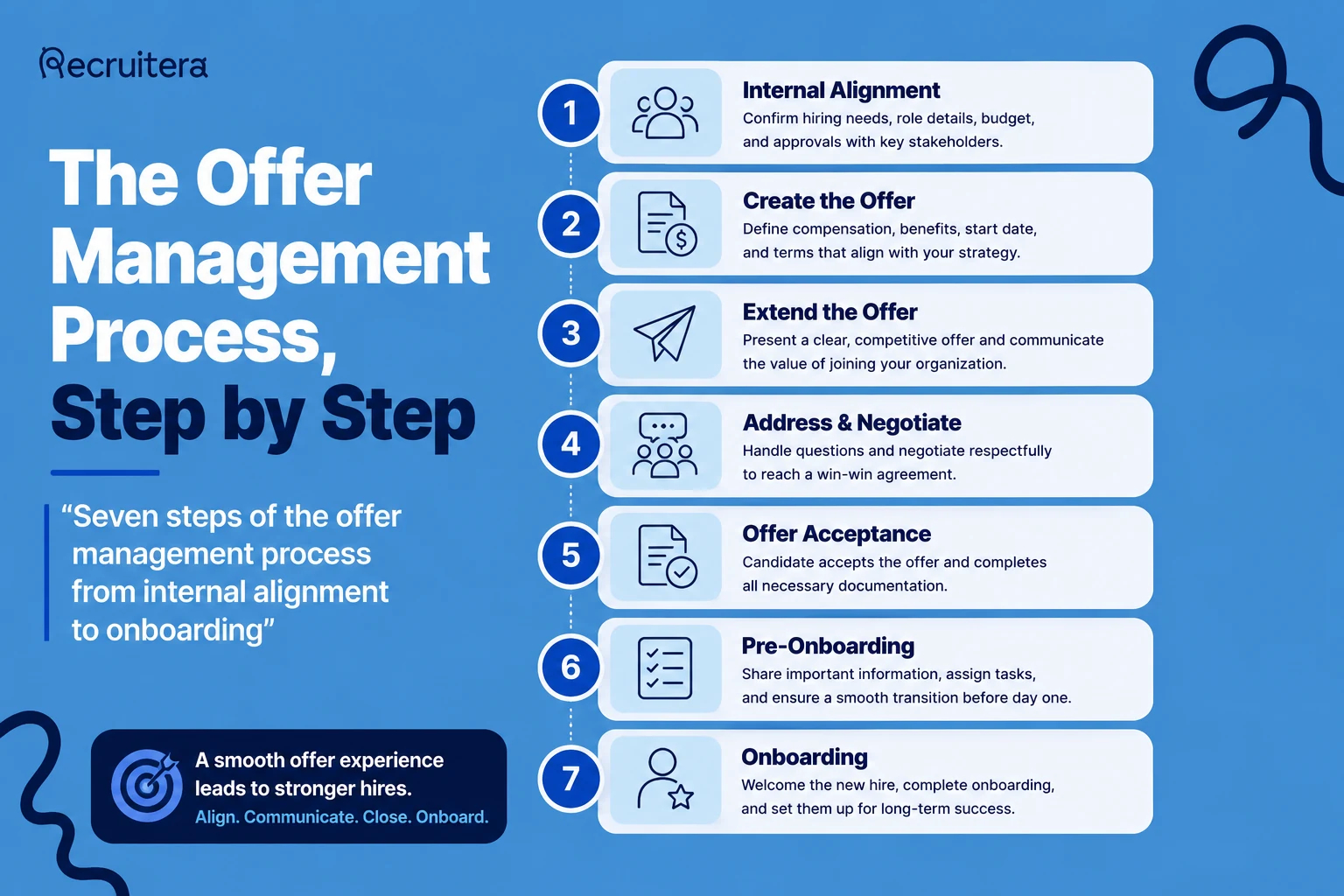

The offer stage is the final stretch of recruitment — and the part where the most damage gets done. You can run a flawless pipeline for six weeks and still lose the hire in the last 48 hours if the offer is slow, unclear, or inconsistent. The offer management process is the set of steps that takes you from a selected candidate to a signed contract.
In MENA, the stakes are higher. Strong candidates are usually interviewing in three or four places at once, and counteroffers from a current employer are common. The team that moves cleanly through the offer stage is the team that wins.
For the full picture — what offer management is, the data on declined offers, metrics, and tools — read our complete guide: What Is Offer Management? Process, Best Practices & Tools. That is your reference. This guide is the operational companion: how to actually run each step well, and exactly where teams lose the candidate.
What the offer management process covers
At a high level, offer management runs from selection to start date. It sits right after your final interview and just before onboarding. It is not simply "send the offer letter." It is everything around that: aligning internally, building the package, getting it approved, extending it well, handling negotiation, securing acceptance, and handing off cleanly so the candidate does not drift away before day one. Here are the seven steps.
Step 1: Align internally before you build anything
The process starts inside your company, not with the candidate. Before anyone drafts an offer, the recruiter and hiring manager need to agree on the essentials: the level, the salary range, the start date, and any extras like allowances, variable pay, or relocation. Loop in finance or HR early if the number sits outside the approved band — that is the conversation that quietly eats three days later if you skip it now. A short alignment step here prevents the most painful failure in the whole process: extending an offer you have to walk back.
Step 2: Build the offer
Now you assemble the actual package. A complete offer in the MENA context usually includes base salary stated clearly in EGP or local currency, benefits and allowances, any variable pay with how it is earned, the start date and contract type with probation period in line with local labour law, and the reporting line and job title.
Use a standardised template so every candidate at the same level gets a consistent, professional document. Consistency is not just tidy — it keeps you fair and reduces legal exposure. For pay, lean on regional benchmarks rather than global salary surveys that do not reflect the local market (Mercer's Middle East compensation surveys are a reliable reference). And structure the letter properly — SHRM's offer letter guidance is a solid template to work from. Just remember to add the human touches: reference the conversations you had, name the growth path, and keep the language warm. A template should be the skeleton, not the whole letter.
Step 3: Route the offer for approval
Almost every offer needs at least one sign-off — a manager, finance, or both — before it goes out. This is where speed dies. An offer sitting in someone's inbox for three days is three days your competitor's offer is working. Keep this step tight: know in advance who approves what, set a clear turnaround expectation, and chase actively. The goal is hours, not days.
Approvals are a deep topic on their own — routing, multi-level sign-off, and escalation. For the full breakdown, see the internal-approval workflow in our offer management guide; a dedicated guide to the offer letter approval process is coming next in this series.
Step 4: Extend the offer
In MENA, the strongest move is almost always verbal first, written second. Call the candidate. Tell them the news directly, walk them through the headline numbers, and gauge their genuine reaction — you will learn more in two minutes on the phone than in two days of email silence. Then follow immediately with the formal written offer so nothing depends on memory.
Two things matter most here. First, speed: get the written offer out the same day as the verbal one wherever you can, because momentum fades fast. Second, clarity: spell out what happens next and by when. Candidates who know the timeline do not go looking elsewhere out of anxiety — the same dynamic behind candidate ghosting.
Step 5: Handle negotiation
Expect a counter. A candidate asking for more is usually a buying signal, not a rejection. Know before the call what is flexible — start date, signing bonus, a small base adjustment — and what is not. Respond quickly: a negotiation that drags gives a current employer time to make a counteroffer, one of the most common ways MENA hires fall through at the last step. If you cannot move on a number, move on something else: an earlier review, a clearer growth path, an extra allowance. The aim is a fast, fair close the candidate feels good about — not winning every point.
Step 6: Secure the acceptance
Get the "yes" in writing, with a signature. Make signing effortless: e-signature, any device, a clear deadline. The harder it is to accept, the more room there is for second thoughts. Record the accepted terms and the signed document somewhere central — not a personal folder. You will want that trail later.
Step 7: Hand off to onboarding without going dark
The single most underrated step. The gap between "accepted" and "first day" is where renegues happen — especially when a notice period is long and a counteroffer is still on the table. Do not go silent. Keep the candidate warm with pre-boarding: a welcome note, paperwork, a first-week preview, an introduction to the team. A candidate who feels connected before day one is far less likely to back out. Then hand the file cleanly to whoever owns onboarding, with all the accepted terms attached.
Where the offer process usually breaks
Most lost offers come down to a short list of repeat failures: slow approvals that let the offer age, going silent for long stretches, inconsistent offers across similar roles, verbal-only offers with no paper trail, and ignoring the counteroffer risk during the notice period.
Notice the pattern: almost all of these are speed and visibility problems. Fix those two and your offer acceptance rate climbs toward the healthy 80 to 90% range that high-performing talent teams target (AIHR benchmarks) — and your time-to-hire drops with it.
How an ATS runs the offer process for you
Doing all of this by hand — across email, spreadsheets, and WhatsApp threads — is exactly why offers stall. An applicant tracking system pulls the whole process into one place: offer templates that keep every offer consistent and fast to build, built-in approval routing that shows you exactly where an offer is stuck, e-signature so candidates accept from any device in minutes, and a full activity trail that records every step from verbal offer to signed acceptance.
Inside Recruitera, the offer step lives right in the candidate pipeline, so the recruiter never leaves the system to extend, track, or close an offer.
Offer management in high-volume and blue-collar hiring
The standard process assumes one offer at a time. High-volume and blue-collar hiring breaks that assumption — you might be extending dozens of offers a week to candidates who do not check email. Here the channel matters as much as the steps. WhatsApp dramatically outperforms email for reaching these candidates, accepting offers, and confirming start dates in real time. If you are hiring at volume in MENA, see WhatsApp vs. Job Boards for high-volume hiring — the offer step is exactly where the channel choice pays off.
Frequently Asked Questions
What are the steps of the offer management process?
The offer management process has seven core steps: align internally, build the offer, route it for approval, extend it verbally then in writing, handle negotiation, secure a signed acceptance, and hand off to onboarding without going silent.
How long should the offer stage take?
Aim for hours and days, not weeks. The faster a complete, approved offer reaches the candidate after the final interview, the higher your acceptance rate — every day of delay gives a competing offer more room.
Should I make a verbal or a written offer first?
Both. In MENA, extend the offer verbally on a call first to read the candidate's reaction and build momentum, then follow the same day with a formal written offer so the terms are documented.
Who approves a job offer?
Usually the hiring manager, and finance or HR when the package sits outside the approved band. Decide who approves what before you build the offer so the approval step does not add days.
How do you reduce offer drop-off?
Move fast, never go silent, keep offers consistent, get acceptance in writing, and stay in touch through the notice period with pre-boarding so the candidate does not renege before day one.
A strong offer process is mostly about speed and visibility — exactly what a system gives you. Recruitera lets your team build, approve, send, and close offers inside the same pipeline you already work in. Book a quick demo to see how it runs the offer stage end to end.
Ready to Hire Smarter?
Recruitera helps you see the person behind the resume. Book a quick demo and discover a better way to build your team.
Book a Demo


Recruiters' first go-to knowledge hub.
Visit resources →Practical guides on sourcing, interviewing and employer branding in MENA.
Read the blog →Job descriptions, offer letters, interview scorecards and onboarding checklists, ready to copy.
Browse templates →New features, improvements and release notes from the Recruitera team.
See what's new →