What Is Offer Management? Process, Best Practices & Tools
What Is Offer Management? Process, Best Practices & Tools
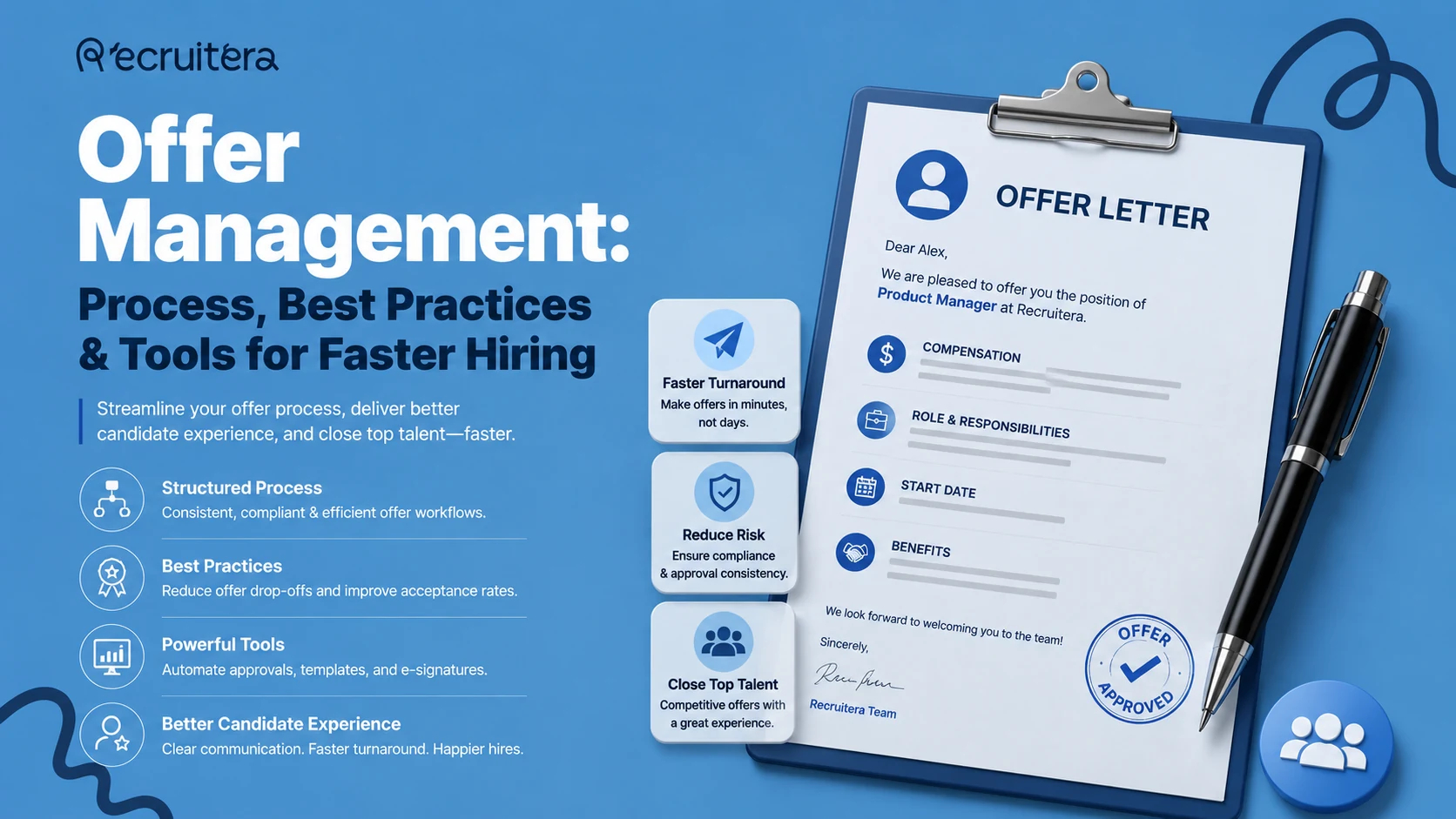

Offer management is the final stage of recruitment, and it is the most fragile. Choosing the right candidate is not the end of hiring. The real success happens when the offer is approved quickly, sent clearly, accepted confidently, signed digitally, and moved smoothly into onboarding.
This guide covers the full offer management process, the data on why candidates decline offers, and the practices that consistently improve acceptance rates for hiring teams in Egypt and the MENA region.
What Is Offer Management?
Offer management is the process of preparing, approving, sending, negotiating, tracking, and finalizing job offers. It covers everything that happens between selecting a candidate and receiving their signed contract.
| Area | What It Covers |
|---|---|
| Offer preparation | Defining salary, title, benefits, start date, and work model |
| Internal approval | Getting sign-off from HR, hiring manager, finance, or leadership |
| Offer letter creation | Generating a clear, professional offer document |
| Candidate communication | Sending the offer and answering candidate questions |
| Negotiation | Managing salary, title, benefits, or joining date discussions |
| E-signature | Allowing candidates to sign the offer digitally |
| Offer tracking | Monitoring offers that are sent, viewed, accepted, rejected, or expired |
| Onboarding handoff | Moving accepted candidates into the onboarding process |
Why Does Offer Management Matter?
A weak offer process can cost a company a strong candidate after weeks of investment in sourcing, screening, and interviewing. A delayed offer is not just an operational issue. It can directly become a lost hire.
Research on declined offers shows that compensation is the primary reason in only about 35% of cases. The remaining 65% come from problems that were established earlier in the process or during the offer stage itself: competing offers that moved faster, unclear expectations, poor communication, or a candidate experience that created doubt before the offer was even sent.
66% of candidates say a positive hiring experience directly affects their decision to accept an offer. 26% of candidates have declined offers because of poor communication or unclear expectations. These are process problems, and process problems are fixable.
Common problems and their impact:
| Problem | Impact |
|---|---|
| Slow internal approvals | Candidate accepts another offer while waiting |
| Unclear salary or benefits | Candidate loses trust in the company |
| Manual offer letters | Higher chance of errors and inconsistency |
| Poor communication after sending | Candidate feels uncertain and disengaged |
| No offer tracking | HR cannot identify where offers are getting stuck |
| No rejection reason tracking | Company cannot improve future offers |
See how Recruitera's offer management module works, book a quick demo.
Why offers get declined
35%
of declines are caused by compensation
65%
are caused by process, slow approvals, poor communication, or a faster competitor
Most common rejection reasons
The Offer Management Process
The offer management process
STEP 1
Final candidate selection
STEP 2
Compensation alignment
STEP 3
Candidate pre-closing
STEP 4
Internal offer approval
STEP 5
Offer letter creation
STEP 6
Sending the offer
STEP 7
Negotiation management
STEP 8
Acceptance or rejection
STEP 9
Handoff to onboarding
Step 1: Final Candidate Selection
The hiring team agrees on the selected candidate after reviewing interviews, assessments, evaluation forms, and hiring manager feedback. Everyone involved in the decision should be aligned before the offer process begins.
Step 2: Compensation Alignment
Before drafting anything, HR should confirm the full compensation package. For MENA-based teams, this means using regional benchmarks rather than global salary surveys that do not reflect local market conditions.
| Item | Details |
|---|---|
| Salary | Monthly gross or net salary |
| Benefits | Medical insurance, bonus, allowances |
| Work model | Onsite, hybrid, or remote |
| Contract type | Full-time, part-time, or contractor |
| Start date | Expected joining date |
| Notice period | Candidate availability |
| Reporting line | Direct manager |
| Approval level | Who must approve the offer |
Get the compensation range signed off before sourcing begins, not after the candidate has been selected. For MENA salary benchmarks by role and industry, Mercer's Middle East compensation surveys are a reliable reference.
Step 3: Candidate Pre-Closing
Before sending the official offer, the recruiter should check in with the candidate. This step is often skipped, and skipping it is one of the most common reasons offers get declined.
Questions to cover before sending:
- Is the candidate still interested and actively engaged?
- Is their salary expectation aligned with what you are about to offer?
- Does the candidate have other offers in progress?
- What is their notice period?
- What matters most to them beyond base salary?
- Is there anything that could block their acceptance?
This conversation surfaces negotiation or hesitation before it becomes a formal decline. Candidates who receive a verbal walk-through before the written offer accept at significantly higher rates than those who receive a cold document without any prior discussion.
Step 4: Internal Offer Approval
The offer should be reviewed and approved by the right stakeholders before it goes to the candidate. Common approvers include the recruiter, hiring manager, HR manager, finance, department head, and for senior roles, leadership or the CEO.
Approval workflows should be clear, time-bound, and trackable. An approval chain that takes 11 days means the candidate has been waiting almost two weeks between the final interview and receiving anything in writing. During that time, 41% of lost offers go to competing employers who moved faster. Slow approval chains also add days to your time-to-hire, one of the metrics hiring managers are most commonly measured on.
For most standard offers, a two-step approval covering the hiring manager and HR is sufficient. Every other level of approval is a delay you are adding voluntarily.
Step 5: Offer Letter Creation
A complete offer letter should include:
| Section | Details |
|---|---|
| Candidate name | Full legal name |
| Job title | The approved role |
| Department | Team or function |
| Salary | Compensation details |
| Benefits | Insurance, bonus, allowances |
| Start date | Joining date |
| Work location | Office, remote, or hybrid |
| Working hours | Schedule or shift |
| Reporting manager | Direct manager |
| Conditions | Background check, documents, probation period |
| Signature | Candidate acceptance confirmation |
For Egyptian hires, include Social Insurance registration details as required under Egyptian Labor Law. For Gulf roles, include housing allowance, medical coverage, and visa or Iqama status where applicable. SHRM's offer letter guidance is a useful reference for structuring compliant, professional offer documents.
Step 6: Sending the Offer
Send the offer quickly after internal approval. Every day of delay is a day the candidate is being courted by someone else.
Best practices when sending:
- Use a clear subject line so the candidate knows what they are opening.
- Add a warm personal message alongside the formal document.
- Explain the deadline clearly and why there is one.
- Mention the next steps after acceptance.
- Make it easy for the candidate to ask questions.
- Use digital delivery with e-signature so the candidate does not need to print, scan, or visit an office.
Set a clear expiry date. A 3 to 5 working day window is standard. Long enough for the candidate to evaluate properly, short enough to maintain momentum.
Step 7: Negotiation Management
Most candidates will negotiate. This is normal and should be treated as a positive signal. Candidates who negotiate and reach a mutually acceptable outcome are often more engaged early employees than those who accepted without pushback.
Common items candidates negotiate:
- Base salary
- Title
- Benefits or allowances
- Work model
- Start date
- Notice period
- Bonus structure
- Relocation support
Know your limits before the conversation starts. Decide what can move and what cannot. Document every update to avoid confusion. Avoid reopening package elements that the candidate did not raise.
Step 8: Offer Acceptance or Rejection
Track the final status of every offer. Not tracking outcomes makes it impossible to improve.
| Status | Meaning |
|---|---|
| Draft | Offer is being prepared internally |
| Pending approval | Waiting for internal sign-off |
| Approved | Ready to send to the candidate |
| Sent | Delivered to the candidate |
| Viewed | Candidate has opened it |
| Accepted | Candidate has agreed verbally or in writing |
| Signed | Candidate has signed the offer |
| Rejected | Candidate has declined |
| Expired | Deadline passed without a response |
Step 9: Handoff to Onboarding
Once the candidate accepts, the process should move to onboarding without delay. A smooth handoff reinforces the candidate's decision and reduces the risk of pre-start drop-off. Candidates who ghost after accepting an offer, a growing problem in 2026, are almost always ones who heard nothing between signing and starting.
The handoff typically includes: collecting documents, creating the employee profile, preparing the contract, sending a welcome email, assigning onboarding tasks, informing payroll and IT, and sharing first-day details.
Ready to cut your approval time? See how Recruitera automates the hiring workflow.
Best Practices for Offer Management
Move fast after the final interview. The longer the gap between decision and offer, the higher the chance of losing the candidate. Most strong candidates are interviewing elsewhere simultaneously.
Align salary expectations early in the process. Do not wait until the offer stage to discover a salary mismatch. Compensation conversations should happen at the first or second interview stage so there are no surprises at the end.
Use standard offer templates for different role types. Create templates for full-time roles, part-time roles, internships, sales roles, senior management, remote roles, and different locations. Consistency protects you legally and speeds up the process.
Automate approval workflows. Manual approvals through email or messaging apps delay hiring and create gaps where offers get lost. A structured workflow makes it clear who needs to approve, by when, and what happens if they do not respond.
Use e-signatures. Digital signing reduces time from offer sent to offer signed from days to hours.
Keep the candidate warm after sending. After the offer goes out, stay engaged. Check in after 24 hours. Answer questions quickly.
Track rejection reasons systematically. Every declined offer should have a documented reason. The patterns that emerge over time tell you exactly where your process or your package needs work.
Common rejection reasons to track:
| Rejection Reason | What It Points To |
|---|---|
| Salary below expectation | Compensation benchmarking problem |
| Benefits not competitive | Package structure problem |
| Location inconvenient | Role setup or flexibility problem |
| Candidate prefers remote or hybrid | Work model problem |
| Counteroffer from current employer | Speed or engagement problem |
| Candidate accepted a faster offer | Process speed problem |
| Role did not match expectations | Communication problem earlier in the process |
| Poor candidate experience | Overall process quality problem |
Which Metrics Should You Track in Offer Management?
| Metric | Why It Matters |
|---|---|
| Offer acceptance rate | Measures how many sent offers are accepted |
| Offer rejection rate | Shows how many candidates decline |
| Time from final interview to offer sent | Measures how fast you move after a decision |
| Time from offer sent to acceptance | Measures candidate decision time |
| Approval SLA | Shows where internal delays are occurring |
| Rejection reasons | Helps improve future offers |
| Counteroffer rate | Shows how competitive your packages are |
| Offer drop-off by department | Identifies which teams have the biggest problems |
| Offer drop-off by role type | Helps improve role-specific offers |
Offer acceptance rate formula:
Offer Acceptance Rate = Accepted Offers divided by Total Offers Sent, multiplied by 100.
Example: You sent 50 offers and 40 were accepted. 40 divided by 50 multiplied by 100 equals an 80% offer acceptance rate.
Offer acceptance rate benchmark — 2026
Below 75%
Consistent friction at the offer stage. Investigate immediately.
TARGET RANGE
80 to 90%
High-performing talent teams in 2026.
Above 90%
Strong employer brand and well-calibrated compensation.
According to AIHR's 2026 benchmarking data, high-performing talent teams aim for a rate in the 80 to 90% range. A rate above 90% indicates strong employer brand positioning and well-calibrated compensation. A rate below 75% is a clear signal of consistent friction at the offer stage.
Tools for Offer Management
| Tool Type | Purpose |
|---|---|
| ATS or hiring platform | Manage candidates, approvals, offer status, and hiring workflow in one place |
| E-signature tool | Allow candidates to sign the offer digitally |
| HRIS | Move accepted candidates into employee records automatically |
| Onboarding tool | Manage documents, tasks, and first-day preparation |
| Compensation benchmarking tool | Maintain internal equity and benchmark against the market |
| Communication tool | Send updates, reminders, and negotiation messages |
| Reporting dashboard | Track acceptance rate, rejection reasons, and processing delays |
The most important thing is that these tools work together. When offer creation, approval, signature, and tracking all happen in separate systems, offers fall through the gaps.
Recruitera handles the full offer management process inside a dedicated ATS built for MENA hiring teams. Draft offers from templates, route them through your approval chain automatically, send with digital signature, and track acceptance in real time. Templates can be configured for both English and Arabic. Book a demo to see how it works on a live role.
Manual Offer Process vs Digital Offer Management
Most hiring teams start with a manual offer process: email chains, shared drives, and approval requests over WhatsApp or Slack. It works at low volume, but breaks down quickly as hiring scales. Here is how the two approaches compare across the stages that matter most.
| Manual Offer Process | Digital Offer Management |
|---|---|
| Email chains for approvals | Automated approval workflows with defined SLAs |
| Slow approvals, days or weeks | Real-time approvals with automatic notifications |
| Template inconsistencies across departments | Standardized templates for every role type and location |
| No tracking, offers lost in inboxes | Real-time offer status tracking from draft to signed |
| Manual follow-up on unsigned offers | Automated reminders when offers approach expiry |
| Print, sign, scan for acceptance | Digital e-signature from any device in minutes |
| No rejection reason data | Structured decline tracking with reason codes |
| Handoff to onboarding done manually | Automatic trigger to onboarding workflow on acceptance |
The shift from manual to digital is not about replacing the recruiter's judgment. It is about removing the administrative friction that slows every stage down and creates gaps where candidates fall through.
Frequently Asked Questions
What is offer management in recruitment?
Offer management is the end-to-end process of preparing, approving, presenting, negotiating, tracking, and finalizing job offers. It covers everything from the internal hiring decision to the signed employment contract and onboarding handoff.
What is a good offer acceptance rate?
High-performing talent teams in 2026 aim for an offer acceptance rate in the 80 to 90% range. Above 90% indicates strong employer brand positioning and well-calibrated compensation. Below 75% is a signal that something in the offer stage is causing consistent friction that needs investigation.
Why is efficient offer management important?
Because the offer stage is where good hires are most commonly lost. Slow approval chains, unclear packages, and poor communication lose candidates to faster competitors, often after weeks of investment in sourcing and interviewing. A structured offer process protects that investment and improves the candidate's first impression of the company.
Ready to Hire Smarter?
Recruitera helps you see the person behind the resume. Book a quick demo and discover a better way to build your team.
Book a Demo

Recruiters' first go-to knowledge hub.
Visit resources →Practical guides on sourcing, interviewing and employer branding in MENA.
Read the blog →Job descriptions, offer letters, interview scorecards and onboarding checklists, ready to copy.
Browse templates →New features, improvements and release notes from the Recruitera team.
See what's new →