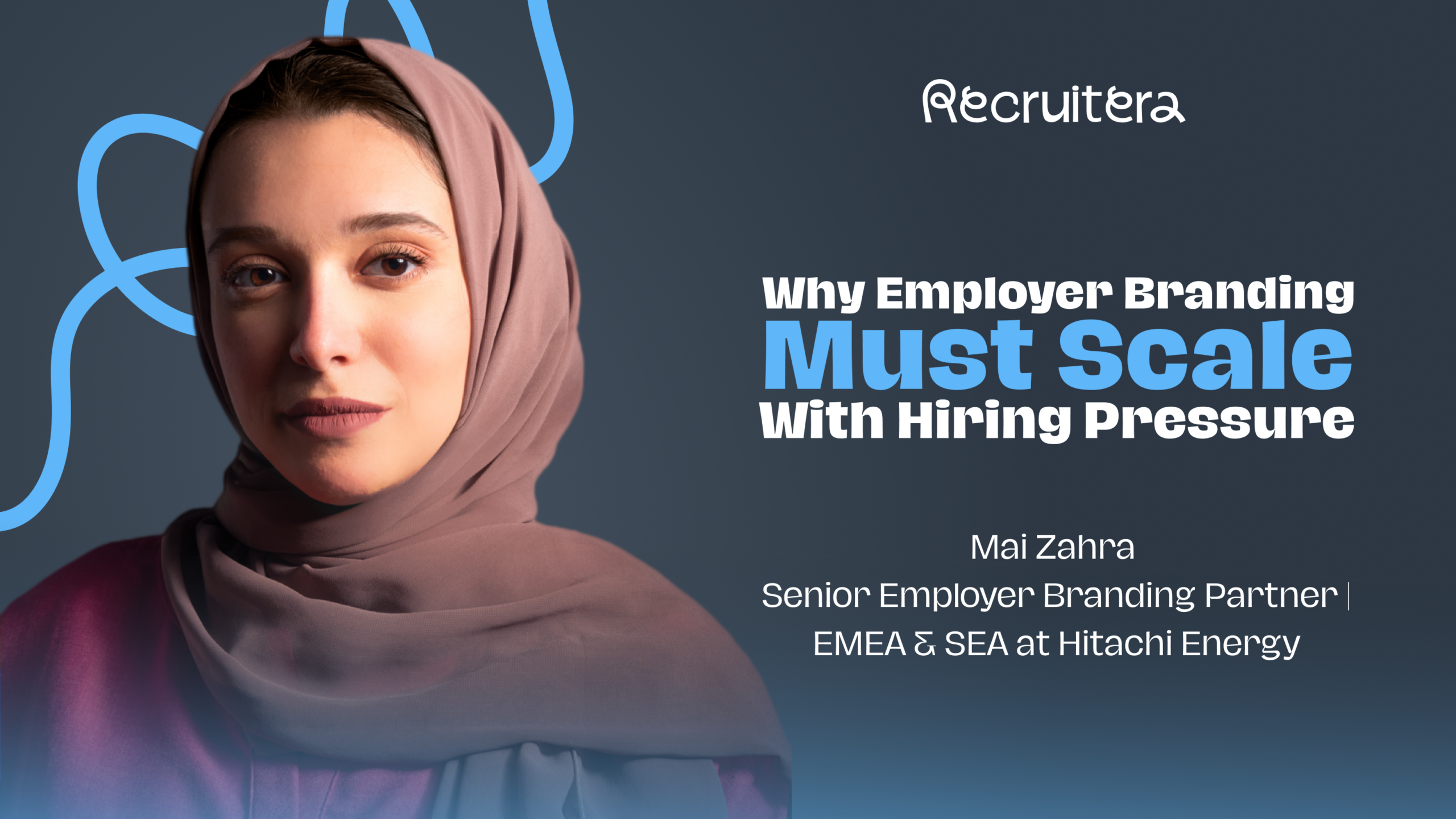
Why Employer Branding Must Scale with Hiring Pressure | By Mai Zahra
Expert employer branding strategies for scaling your brand under hiring pressure — advice from a senior employer branding professional.

High-volume hiring does not simply mean "many open roles." It means accelerated timelines, overlapping requisitions, hiring managers under pressure, and recruiters balancing dozens of candidate conversations at once. It also means risk — risk of inconsistent messaging, risk of candidate drop-off, risk of new hires joining with unclear expectations, and risk of experienced recruiters burning out.
In these phases, the relationship between Talent Acquisition and Employer Branding becomes more critical than ever.
A few years ago, I sat in a meeting where the only slide that mattered showed three numbers: open roles, time to hire, and projected growth. Experience was not on that slide. It simply was not urgent enough to compete with delivery targets. In that moment, I realized: Employer Branding cannot sit back when hiring pressure rises. It must become more practical, more integrated, and more hands-on. Not louder — more operational.
Why High-Volume Hiring Creates Strain
When hiring volume spikes, speed becomes the dominant priority. Under that pressure, misalignment spreads quickly. A hiring manager may describe the role differently than the job advertisement. An employee ambassador may not fully understand how to speak about growth externally. Recruiters may spend valuable time clarifying positioning instead of progressing candidates through the funnel.
None of this is caused by poor intent. It is caused by scale without structured alignment. And that is precisely where Employer Branding matters most.
Employer Branding as a Scaling Partner
Employer Branding is not there to critique Talent Acquisition. In high-volume hiring phases, EB is an extension of TA — working side-by-side to scale communication, strengthen alignment, and reduce unnecessary friction. When positioned correctly, EB co-owns hiring outcomes.
- EB can align job messaging across channels, reducing repetitive explanations and enabling recruiters to move candidates faster.
- EB can provide clear messaging frameworks and talking points to protect clarity when hiring managers deliver inconsistent narratives.
- EB can equip employees with structured content and guidance, allowing them to amplify growth confidently and consistently.
In each case, EB reduces operational load. This is not brand theory — it is workload management and risk mitigation during scale.
What Breaks Under Pressure
Experience rarely collapses dramatically. It weakens in small, operational ways: a delayed update because a recruiter is handling too many open roles, a candidate accepting an offer with slightly different expectations, a new hire realizing the growth narrative was unclear. Individually, these moments are understandable. At scale, they compound quickly.
That is why EB cannot function only as a campaign engine during growth. It must function as an alignment engine. The faster hiring moves, the more critical consistency becomes.
Why EB Matters More When Urgency Increases
In calmer periods, Employer Branding focuses on attraction and storytelling. In high-volume hiring phases, its role shifts to protecting clarity, consistency, and credibility while speed increases. This means ensuring that the growth story reflects operational reality, supporting TA with ready-to-use messaging assets, and bringing candidate insight into discussions without slowing execution.
When EB understands the operational strain TA faces, it can design solutions that reduce pressure rather than add layers of approval. Instead of being perceived as the function that protects the brand, EB becomes the function that helps the business scale responsibly.
A Final Reflection
Every growth phase tests an organization. It tests speed, alignment, and communication. But it also tests whether Employer Branding can move from concept to contribution.
When hiring pressure rises, the employer brand is not shaped by what is published externally. It is shaped by how consistently people speak, hire, and onboard under stress. And when EB and TA stay closely connected in protecting that consistency, the partnership becomes a steady source of clarity and momentum for the entire organization.
Mai Zahra is a Senior Employer Branding specialist working across global growth environments at Hitachi Energy.
Ready to Hire Smarter?
Recruitera helps you see the person behind the resume. Book a quick demo and discover a better way to build your team.
Book a Demo

Recruiters' first go-to knowledge hub.
Visit resources →Practical guides on sourcing, interviewing and employer branding in MENA.
Read the blog →Job descriptions, offer letters, interview scorecards and onboarding checklists, ready to copy.
Browse templates →New features, improvements and release notes from the Recruitera team.
See what's new →