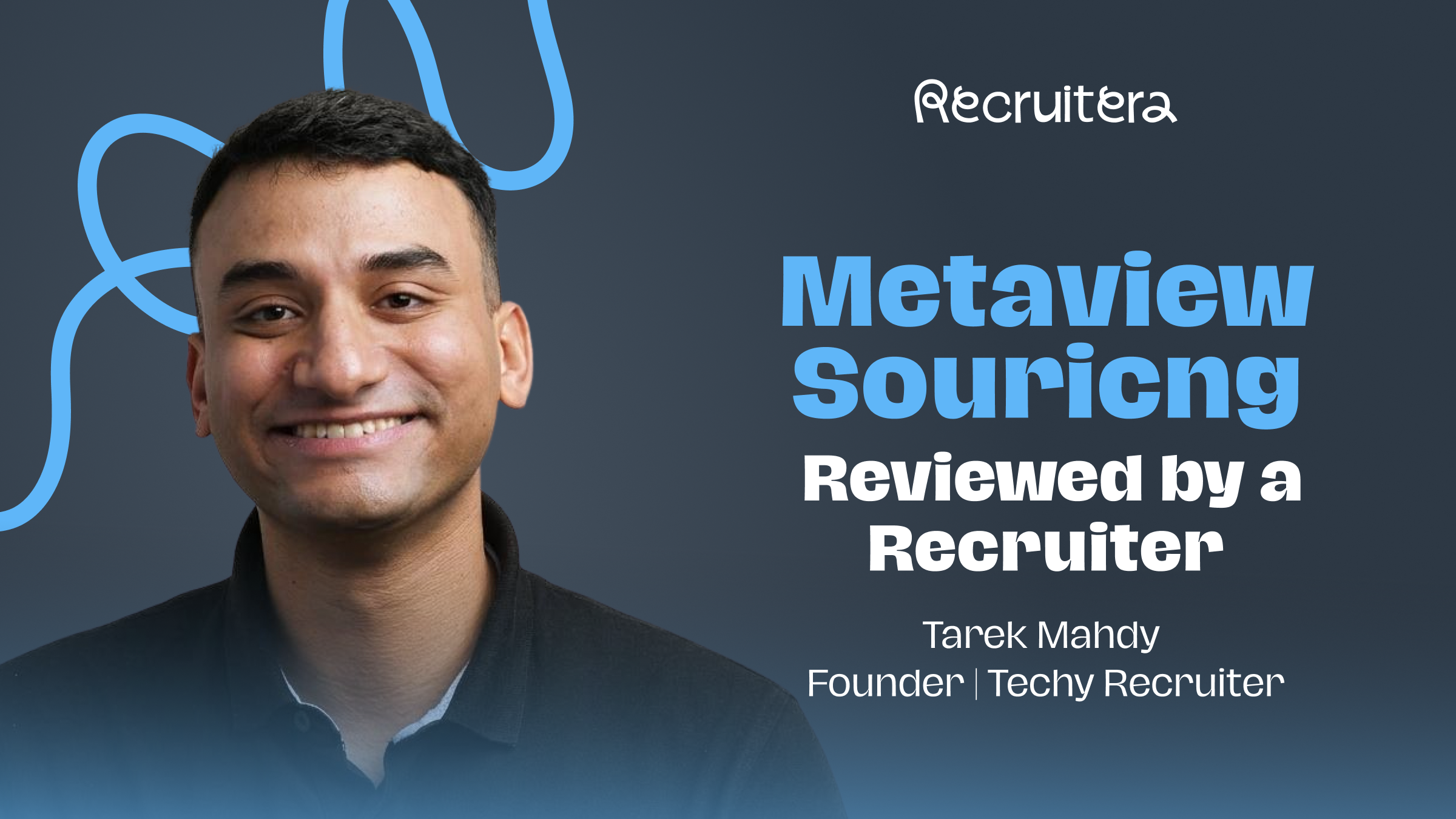
Metaview Sourcing Review: A Recruiter's Honest Playbook | By Tarek Mahdy
An honest Metaview sourcing review from a recruiter — how this AI sourcing agent works in real workflows and whether it's worth it.

One day, while checking a recorded intake call, a notification popped up. My eyes instantly glazed. Yes, it was a notification. But it was a prompt to try Metaview's new sourcing agent.
Not much was needed from me. One click. And that recently recorded intake call was used to refine the search criteria. Metaview's agent created the criteria, searched, filtered, and refined, then handed me 50 candidates to start with.
And it did not stop there.
It asked me to start giving feedback right away. If a candidate looked good, I could say why. In simple English.
This is where this kind of tech takes an edge. It understands nuance. It understands plain language. It understands "simple words". It turns sourcing into a breath.
It's these little moments when sourcing becomes fun again. Metaview brought back the fire.
So I wanted to write this piece, but I also wanted to go beyond my own experience. I went hunting for people talking about it outside of Metaview. My rule was simple: this needs to be recruiter-friendly, and it needs to be a playbook you can use without fooling yourself.
The sourcing problem we keep repeating
Sourcing fails in the same few places. Not because recruiters are bad. Because the work gets messy fast.
You see it daily. Intake calls feel like a conversation, not a spec. The brief shifts mid week. Hiring managers reject profiles without giving a useful signal. Recruiters build lists… and then those lists get neglected. "Good candidate" means something else for each interviewer. The ATS becomes a graveyard of notes nobody reads.
If an AI sourcing tool helps, it needs to improve one thing: your speed to clarity. Not your speed to a bigger list. Because a bigger list can still be a wrong list. And wrong lists burn everyone out. Recruiters. Hiring managers. Candidates.
The moment it clicked for me
The part that surprised me was not "wow it found candidates". Every tool finds candidates. The surprise was this: it started with an intake call.
Not a polished JD. Not a recruiter guessing game. Not me doing the usual dance of "let me translate this vague brief into a Boolean that sort of works". It took what was said, then it turned it into something usable. A refined search criteria that actually looked like a recruiter wrote it.
And then it did the thing we all do manually. It created a few different angles, tested them in parallel, adjusted based on what came back, and narrowed down with feedback. Except it did that without me opening 12 tabs and losing my mind.
That is the shift. Not automation. The shift is: sourcing starts to feel like a conversation again.
What Metaview Sourcing says it is (in plain recruiter words)
Metaview positions it as an autonomous sourcing agent. Plain version: you give it context, it drafts an Ideal Candidate Profile, you refine it, it searches and returns candidates, you rate candidates yes/maybe/no, you leave feedback, and it reruns with that feedback.
It also talks about "Deep Research" — more like market mapping, not just "find me people". More like: show me how the market looks, show me clusters, show me patterns, help me build a smarter plan before I burn a week sourcing the wrong lane.
The feedback loop is where the real value lives
This is the part I want recruiters to take seriously. Because most teams say they want feedback loops, then they give feedback like: "not relevant" / "too senior" / "no". That is not feedback. That is rejection. And rejection teaches nothing.
What Metaview prompted me to do was different. It nudged me to explain "why". In plain English. And that is where the leverage is. Because sourcing success is mostly calibration, not search. Search is easy. Calibration is the hard part.
So when you give feedback, give usable feedback. Stuff that actually moves results:
- Same stack, but more product ownership, less platform only work.
- Keep frontend depth, drop heavy design systems only profiles.
- We need someone who shipped features end to end, not someone who only maintained.
- Keep the seniority, but move away from big orgs, we want small team shipping.
- Same domain, but more B2B, less consumer.
- Keep React, but add TypeScript depth, not just UI assembly.
This kind of feedback does two things. It helps the tool rerun better, and it forces you to get crisp on what you mean. And that second one is the real win.
Quick reality check: this does not remove the recruiter job
It removes the worst parts. The repetitive parts. The parts that feel like punishment. But it does not remove the recruiter job.
If anything, it shifts the recruiter job back to what it should be. Asking better intake questions. Turning vague wants into real constraints. Translating hiring manager language into candidate language. Protecting candidate experience. Building trust inside the hiring team. Spotting patterns across the market.
This tool still needs a recruiter brain. It just stops wasting that brain on mechanical work.
How I would use this as a real playbook (no pretending, no vibes)
If you want to test Metaview Sourcing properly, do not throw ten roles at it randomly. Pick one role where sourcing is painful. Then follow this flow:
Step one: Treat the intake call as a spec creation moment. Do not let intake be a casual chat. You want outputs. Ask for what success looks like in 90 days. What work they will own. What skills are non negotiable. What can flex. What backgrounds failed before and why.
Step two: Make the Ideal Candidate Profile readable. Not a JD rewrite. A real ICP. Short. Sharp. Testable.
Step three: Give feedback like a recruiter, not like a judge. When the first 50 come in, do not reject fast. Calibrate fast.
Step four: Use "find similar" after a strong interview. This is a power move. When you interview someone great, you finally have real signal. Use it.
My take, in one honest line
Metaview Sourcing does not magically make sourcing perfect. It makes sourcing feel alive again. Because it turns it back into what it should be: a loop, a conversation, a calibration engine. Not a lonely recruiter wrestling filters at 1 AM.
And if you are reading this thinking "ok but will it actually work for my roles", I would frame it like this: If your biggest problem is "I cannot find anyone", this might help. If your biggest problem is "we cannot agree what good looks like", this will help even more. Because it forces clarity. And clarity is the real sourcing cheat code.
Tarek Mahdy, Founder of Techy Recruiter. He helps ambitious teams across Cairo, Amsterdam, Helsinki, and Tokyo hire people who actually move the needle, working with tech startups, DAOs, and consultancies that care about how they hire, not just who.
Ready to Hire Smarter?
Recruitera helps you see the person behind the resume. Book a quick demo and discover a better way to build your team.
Book a Demo



Recruiters' first go-to knowledge hub.
Visit resources →Practical guides on sourcing, interviewing and employer branding in MENA.
Read the blog →Job descriptions, offer letters, interview scorecards and onboarding checklists, ready to copy.
Browse templates →New features, improvements and release notes from the Recruitera team.
See what's new →