AI Resume Screening: The Honest Guide for Egypt & Gulf Hiring (2026)
AI Resume Screening: The Honest Guide for Egypt & Gulf Hiring (2026)
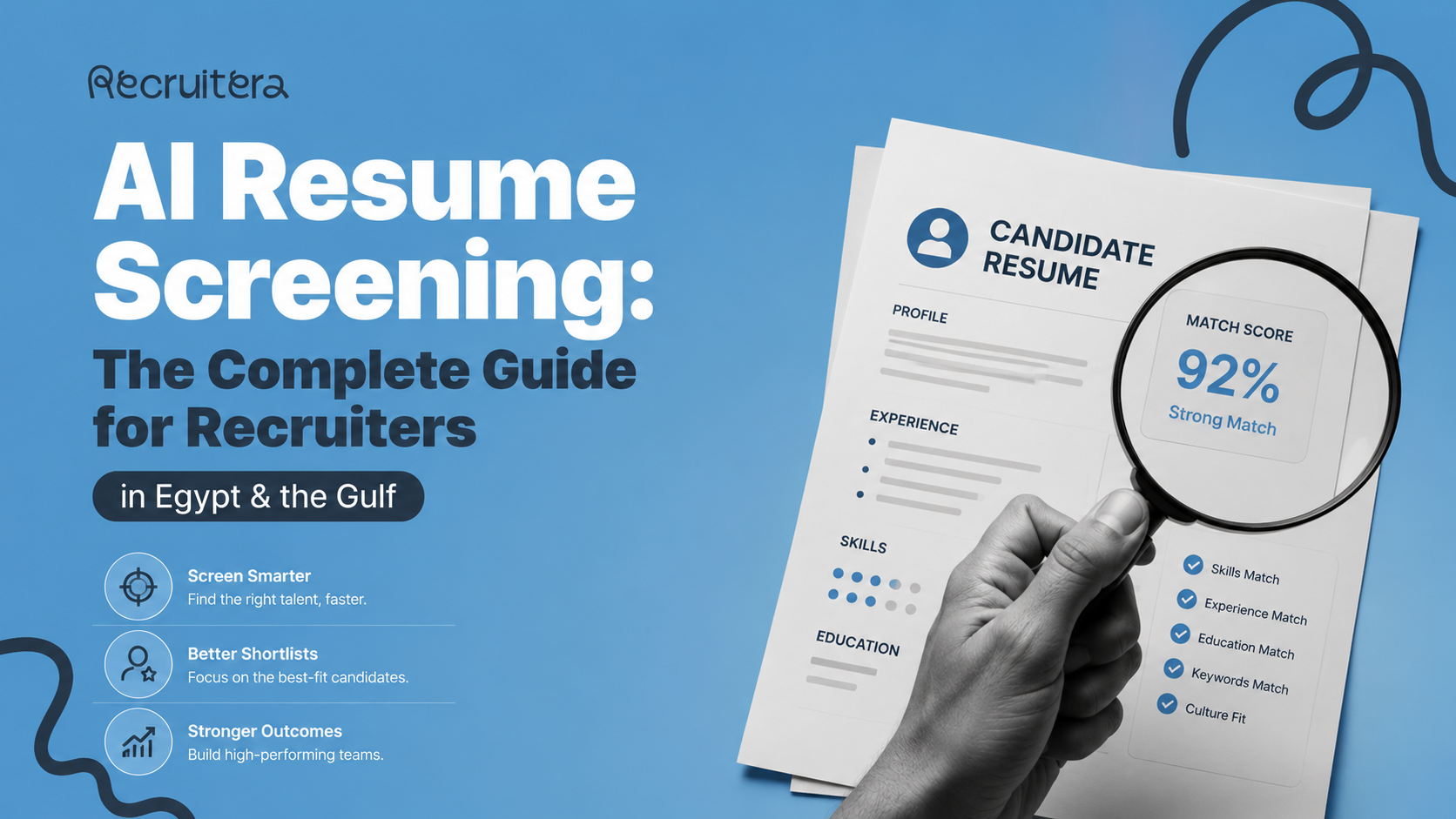

AI resume screening is the use of artificial intelligence to read, rank, and shortlist job applicants by how well they match a role automatically. Instead of a recruiter reading every CV by hand, an AI screening tool parses each resume into structured data, compares it against the job requirements using semantic matching (meaning, not just exact keywords), and produces a ranked shortlist with a fit score for each candidate. The recruiter still makes the final call; the AI just removes the manual sorting.
That is the short answer. But if you hire in Egypt or the Gulf, the standard explanation misses the part that decides whether AI screening actually works for you. So this guide covers everything: how it works, the types of AI involved, what it costs, a real before-and-after example, how it handles Arabic and mixed-language resumes, and how to roll it out without breaking your hiring.
Why Manual Resume Screening No Longer Scales
Start with the problem AI screening exists to solve. The average corporate job posting attracts hundreds of applications; high-volume and blue-collar roles attract thousands. Industry research consistently puts the time a recruiter spends actively reviewing a single resume at around six to eight seconds for the first pass. That tells you everything about how much real evaluation is happening when the pile is that deep.
The maths is brutal. If a recruiter spends even 30 seconds per CV on a role with 400 applicants, that is over three hours of screening for one requisition, before a single conversation happens. Multiply by an open req load of ten or fifteen roles, and screening alone consumes the week. The result is predictable: rushed decisions, strong candidates buried on page nine, and the same recruiter burning out while time-to-hire climbs and good people accept other offers.
Manual screening also hides a quieter problem: inconsistency. The criteria a recruiter applies to CV number 4, fresh on Monday morning, are not the criteria they apply to CV number 240 on Thursday afternoon. That drift is invisible, unmeasurable, and quietly unfair. AI screening exists to attack both problems at once: the volume and the inconsistency.
How AI Resume Screening Works (Step by Step)
Modern AI resume screening follows four stages. Understanding them helps you judge whether a tool is genuinely intelligent or just dressed-up keyword matching.
1. Resume parsing. The system ingests each CV in any format (PDF, Word, scanned image, or plain text) and extracts structured fields: work history, education, skills, certifications, and dates. Good parsers handle messy layouts, tables, multi-column designs, and even content pulled from LinkedIn profiles. Weak ones choke on anything non-standard, which matters more than people expect: a brilliant candidate with an unconventional CV layout can be silently mis-parsed and effectively disappear.
2. Semantic matching. The AI compares the parsed data to your job description, but unlike a basic applicant tracking system that only finds exact keyword matches, semantic matching understands meaning. It knows "ML engineer" and "machine learning engineer" are the same role. It recognises that "managed a team of eight" demonstrates leadership even if the word "manager" never appears.
3. Scoring and ranking. Each candidate receives a fit score against your criteria, and the AI ranks them, often grouped into tiers like Recommended, Under Review, and Not a Match. This is the output recruiters actually use day to day: a prioritised list instead of an undifferentiated pile. The best tools also show why a candidate scored the way they did, so the recruiter can sanity-check the reasoning rather than trusting a number.
4. Filtering and shortlisting. The system surfaces the strongest matches first and flags candidates missing must-have requirements like a required certification, a specific skill, or work authorisation. Critically, nothing should be auto-rejected unless your rules explicitly say so. The recruiter sets the thresholds; the AI applies them consistently.
The Three Types of AI Behind Resume Screening
Not all "AI screening" is the same technology, and the differences affect accuracy and fairness.
Predictive / machine-learning models score candidates based on patterns learned from historical hiring data. They can be powerful, but they are only as good (and as fair) as the data they learned from. A model trained on a narrow or biased history will reproduce that bias at scale.
Natural language processing (NLP) is what powers semantic matching and parsing, understanding the meaning of CV text rather than treating it as keywords. This is the layer that recognises synonyms, context, and related skills.
Generative and agentic AI is the newest layer. Generative AI can summarise a candidate's CV into a recruiter-friendly brief; agentic systems go further, orchestrating multi-step workflows (screening, ranking, summarising, and scheduling) toward a defined goal. Generative models are excellent at summarising but do not verify accuracy on their own, which is exactly why human review stays essential.
The practical takeaway: ask any vendor which of these their tool uses and how. "We use AI" is not an answer.
AI Screening vs. a Traditional ATS Filter
People often confuse the two, and the distinction matters when you are buying. A traditional applicant tracking system filters with static rules and exact keywords. If the job description says "customer relationship management," it looks for that literal phrase and rejects anyone who only wrote "CRM." AI resume screening uses contextual understanding to rank candidates on overall fit. The best modern platforms combine both: the structure and compliance of an ATS with an intelligent AI layer on top.
For the full picture of how these systems fit together, see our guides to the best AI applicant tracking systems and the key features of an applicant tracking system.
The Benefits Recruiters Actually See
Speed and scale. One recruiter can screen hundreds of resumes in minutes rather than days, which directly shortens time-to-hire and lets teams handle volume spikes without adding headcount. (If you run high-volume roles, our guide on how high-volume hiring teams stay organised pairs well with this.)
Consistency. The AI applies the same criteria to every candidate, removing the Monday-morning-versus-Thursday-afternoon drift that creeps into manual review.
Better matches. Semantic matching finds qualified candidates who do not use the exact job-title keywords you wrote, surfacing the strong people a keyword filter buries.
Data-driven decisions. Analytics expose where the funnel leaks and which sources deliver quality, not just quantity.
A Worked Example: Before and After
Consider a regional retail chain hiring 50 store associates across Cairo and Riyadh, drawing roughly 1,500 applications in two weeks.
Before AI screening: two recruiters split the pile. At 30 seconds a CV, that is over twelve combined hours of pure screening. Fatigue sets in, the criteria drift, and several strong bilingual candidates whose CVs are formatted in Arabic get skimmed past. Time to a usable shortlist: about nine days.
After AI screening: all 1,500 CVs are parsed and ranked overnight against the role criteria, grouped into Recommended / Review / Not a Match. The recruiters spend their twelve hours not sorting, but actually evaluating and calling the top tier. The Arabic-formatted CVs are parsed correctly and ranked on merit. Time to a usable shortlist: about two days, with more of the genuinely strong candidates surfaced rather than buried.
The point of the example is not the exact numbers. It is the shift in where recruiter time goes: from sorting to deciding.
The MENA Problem Nobody Talks About: Arabic & Mixed-Language CVs
Here is what the global guides leave out entirely. Most AI screening tools are trained and tuned on English-language, Western-format resumes. In Egypt and the Gulf, the reality on the ground is different, and it quietly breaks tools that look impressive in a demo.
Arabic and bilingual CVs. Many MENA candidates submit resumes in Arabic, or mix Arabic and English in the same document: Arabic for personal details and summary, English for technical skills, or the reverse. A parser not built for Arabic will misread right-to-left text, garble names, or drop entire sections, which means a qualified candidate is scored on a fraction of their actual CV.
Name and transliteration variance. The same candidate's name can appear half a dozen ways in English transliteration: Mohamed, Mohammed, Muhammad, Mohamad; Ahmed or Ahmad. Tools that do not account for this create duplicate records and corrupt the data your reporting depends on.
Local qualifications and employers. A model trained on US or European data does not recognise that a degree from Cairo University, Ain Shams, or King Saud University carries weight, or that experience at a major regional employer is significant. It can systematically undervalue genuinely strong local candidates.
Right-to-left formatting. RTL layouts confuse parsers built for left-to-right documents, scrambling the structured extraction that the entire screening process depends on. If parsing fails, everything downstream fails with it: matching, scoring, and ranking.
This is exactly why a globally-trained tool can dazzle in a sales demo and then underperform on your actual applicant pool. Screening that is calibrated for MENA hiring (native Arabic-language support, transliteration handling, recognition of regional qualifications, and bilingual parsing) produces dramatically more accurate shortlists for Egypt and Gulf teams. When you evaluate a tool, this is the single most important thing to test, and almost no one tells you to.
The Risks: Use AI to Filter, Not to Decide
AI screening introduces real risks if left unchecked, and responsible recruiters plan for them rather than discovering them later.
Bias amplification. A model trained on narrow data can disadvantage non-native speakers, candidates with unconventional career paths, or underrepresented groups. AI does not remove human bias automatically; it can entrench it at scale if no one is watching.
Black-box scoring. If a tool cannot explain why it scored someone the way it did, you cannot defend the decision, audit it, or correct it. Opaque scoring is a liability, not a feature.
Over-reliance. The failure mode is not AI making a bad call. It is a recruiter treating the AI's ranking as a verdict rather than a signal.
The guardrails that matter: insist on explainability, audit results regularly for disparate impact, test the tool on your own historical hires before you trust it, and keep a human in the loop for every meaningful decision. The rule of thumb: use AI to validate, summarise, and compare candidates, never to reject them on its own.
What AI Resume Screening Costs
Pricing models vary. Most tools price in one of three ways: per-recruiter seat (a monthly or annual licence per user), per-hire or usage-based (you pay relative to volume), or enterprise licensing (a custom annual contract for larger teams). AI screening is sometimes bundled into a broader ATS subscription and sometimes sold as a bolt-on module.
To calculate real ROI, do not just compare prices. Estimate the recruiter hours saved, the reduction in time-to-hire (every vacant day has a cost), and the improvement in hire quality measured by early performance or 90-day retention. For MENA teams, factor in whether the tool's accuracy on your actual (often bilingual) applicant pool justifies the spend. A cheaper tool that mis-parses half your CVs is no bargain.
How to Choose an AI Screening Tool: A Checklist
When comparing tools, score each on these dimensions rather than trusting the demo:
1. Matching quality: does it use genuine semantic matching, and can you tune it to your role types?
2. Recruiter control: can you set weights, adjust scoring rules, and override the AI?
3. Explainability: does it show why it scored each candidate, and log decisions for compliance?
4. Language and regional fit. This is the one that decides it for MENA: does it genuinely handle Arabic, bilingual CVs, transliteration, and local qualifications? Test this on your real CVs, not sample data.
5. Integration: does it connect to your job boards, HRIS, and calendar?
6. Bias mitigation: anonymised CV views, fairness testing, disparate-impact tracking.
7. Analytics: dashboards for time-to-hire, source quality, and funnel conversion.
How to Roll Out AI Screening Without Drama
1. Start with one role family. Pilot on a single high-volume role for 4 to 8 weeks rather than flipping it on everywhere at once.
2. Baseline first. Record your current time-to-hire and interview-to-offer rate before the pilot, so you can prove the impact.
3. Test on your real CVs. Especially if you hire in Arabic, run the tool on actual resumes from your pipeline, not the vendor's curated samples.
4. Audit early for bias. Check the shortlist for skew by gender, region, and language, and correct the model weights or rules.
5. Train recruiters to read the scores. A fit score is a signal to investigate, not an order to obey. Appoint an "AI champion" on the team to gather feedback and build confidence.
A Note for Candidates: How to Write an ATS- and AI-Friendly CV
Since candidates read guides like this too, it is worth being clear: AI screening does not "reject you for fun," and there is no magic trick to beat it. The honest advice is to make your CV easy to parse and genuinely matched to the role. Use a clean, single-column layout; standard section headings (Experience, Education, Skills); real words rather than graphics for key information; and the actual terminology from the job description where it is true of you. If you have bilingual skills, state them clearly. Good AI screening is designed to surface qualified people. A clear, honest, well-matched CV helps it do exactly that.
Frequently Asked Questions
What is AI resume screening?
AI resume screening is the use of artificial intelligence to automatically read, rank, and shortlist job applicants based on how well their resume matches a role. It parses each CV into structured data, compares it to the job requirements using semantic matching, and produces a ranked shortlist with a fit score, leaving the final decision to the recruiter.
Does AI resume screening work on Arabic CVs?
Only if the tool is built for it. Many globally-trained screening tools struggle with Arabic text, right-to-left formatting, bilingual resumes, and name transliteration. Screening tools calibrated for MENA hiring handle Arabic and mixed-language CVs accurately, which produces far better shortlists for Egypt and Gulf teams.
Is AI resume screening fair to all candidates?
It can be, if used responsibly. AI can reduce some human bias by applying consistent criteria, but it can also amplify bias if trained on narrow data. Recruiters should require explainable scoring, audit results regularly for disparate impact, and keep a human in the loop for every decision.
Will AI resume screening replace recruiters?
No. It removes the manual sorting, so recruiters can focus on a prioritised shortlist, candidate relationships, and final judgement. AI handles volume; people handle decisions.
How is AI screening different from a normal ATS?
A traditional ATS filters by exact keywords and static rules. AI screening understands context and meaning, recognising synonyms, related skills, and overall fit, so it surfaces strong candidates a keyword filter would miss.
How much does AI resume screening cost?
Pricing is typically per-recruiter seat, per-hire/usage-based, or enterprise licensing, and is sometimes bundled into a broader ATS subscription. Judge it on ROI (recruiter hours saved and reduction in time-to-hire) rather than sticker price alone.
Ready to Screen Smarter in Arabic and English?
Recruitera is built for hiring in Egypt and the Gulf, with AI screening that actually reads your candidates (Arabic CVs included) while keeping you in control of every decision. Book a quick demo and see the difference on your own pipeline.
Ready to Hire Smarter?
Recruitera helps you see the person behind the resume. Book a quick demo and discover a better way to build your team.
Book a Demo

Recruiters' first go-to knowledge hub.
Visit resources →Practical guides on sourcing, interviewing and employer branding in MENA.
Read the blog →Job descriptions, offer letters, interview scorecards and onboarding checklists, ready to copy.
Browse templates →New features, improvements and release notes from the Recruitera team.
See what's new →