

Every once in a while, life hands you a moment that stays with you — not because it was dramatic, but because it quietly reshapes how you see others. An everyday Uber ride became exactly that for me. It was a reminder that potential doesn’t announce itself; sometimes, it sits quietly, waiting for someone to pay attention.
I’m writing this blog to share that moment — and to highlight how powerful it can be when we choose to look beyond assumptions and truly see the people in front of us.
Why Modern Hiring Misses Exceptional Talent — And How One Ride Changed My Perspective
Recruiters talk endlessly about “finding great talent,” yet the systems we build often filter out the very people we claim to be looking for. We rely on job titles, linear career paths, clean CVs, and neatly packaged credentials — assuming they reflect capability.
But capability doesn’t always sit in the places we expect. Sometimes, it sits behind the wheel of an Uber.
A Quiet Confidence That Didn’t Match the Situation
After a long workday, I requested a ride home. The driver greeted me with a calm, grounded confidence — nothing loud or showy, just a presence that made me feel I was speaking to someone with much more depth than his current job suggested.
During the ride, I learned he was from Upper Egypt, a Sohag University graduate who came to Cairo searching for a better future. Like many young professionals who don’t get the right opportunity at the right time, he found himself driving Uber just to survive.
But survival doesn’t erase potential; it only hides it.
Talent Doesn’t Disappear — It Just Becomes Invisible
What struck me was not his situation, but the disconnect between his capability and the role he occupied.
He spoke intelligently, asked thoughtful questions, and showed a level of curiosity you’d rarely find even in a structured interview. And then, casually, he started discussing web development concepts, app structure, and backend logic — with clarity that caught me completely off guard.
It was the kind of knowledge you’d expect from a junior developer, maybe even better than some. Yet nothing in his life circumstances indicated he should be here. And that’s exactly the problem: our hiring systems don’t know how to see people like him.
Because he didn’t have:
- A corporate job title
- A “Relevant” career path
- A clean CV that ticks the right boxes
He was invisible — not because he lacked skill, but because he didn’t fit the template the system recognizes.
The Limitations of Screening: What ATS Will Always Miss
Automated filters and traditional CV screens would have rejected him instantly. Not because he couldn’t do the job — but because the job never got the chance to meet him.
A CV cannot show:
- Hunger
- Grit
- Self-learning
- Curiosity
- Resilience
- Problem-solving instinct
- The ability to figure things out without being taught
Recruiters don’t reject these people intentionally; they reject them unknowingly. Because the system screens them out long before a human ever gets to look.
Human Judgment Is Still the Most Powerful Hiring Tool
There was a moment in the conversation where he hesitated and said:
“Do you think I should go back to university? I don’t have a degree in programming.”
It broke my heart a little, because that’s exactly what our industry has taught him — that knowledge doesn’t count unless paperwork approves it. But talent doesn’t wait for a certificate. So I asked him if he’d like me to secure an interview with him.
He agreed. He prepared. And when he showed up, his work spoke louder than any document ever could.
he was hired.
Not because we lowered the bar — but because we finally looked in a direction the bar wasn’t measuring.
When Opportunity Meets Capability, Trajectories Change
What changed wasn’t just his career. What changed was my own understanding of how many talented people slip through the cracks every single day.
- He didn’t need a degree.
- He didn’t need a perfect CV.
- He needed someone to stop filtering long enough to see him.
And that responsibility sits with us — the people designing and leading hiring systems.
A Question Every Recruiter Should Ask Themselves
1. How many people like him do we reject without ever knowing they existed?
2. How many brilliant minds are working in roles unrelated to their skills simply because no one paused to look deeper?
3. How many “unqualified” candidates are actually capable, driven, and teachable — the exact traits that make exceptional employees?
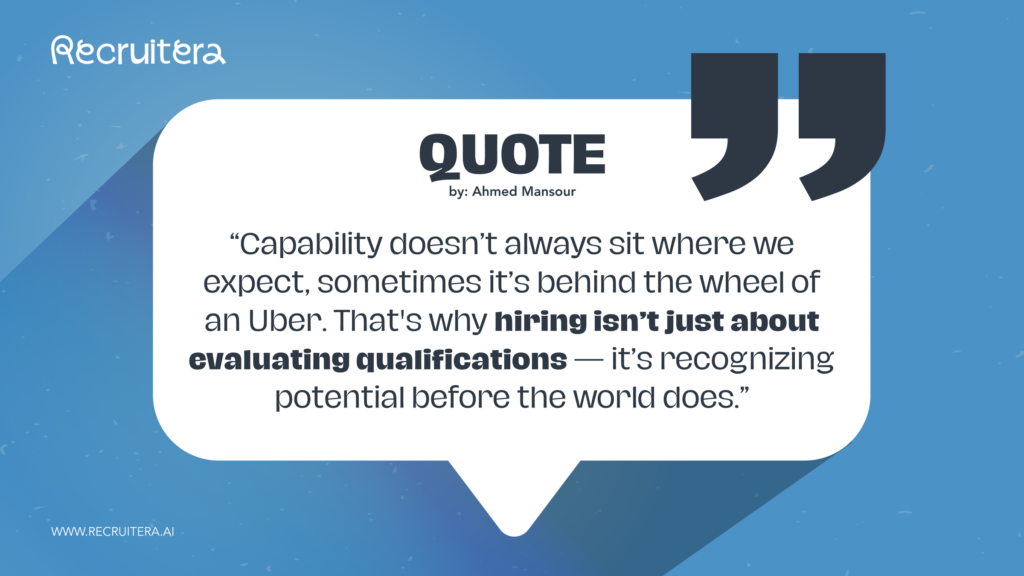
Hiring is not just about evaluating qualifications. It’s about recognizing potential before the world does.
Practical Shifts Recruiters Can Make Today
Here are small, actionable ways to prevent top talent from slipping away:
1. Challenge one screening rule you use too strictly
For example: rejecting candidates because of unrelated job titles.
2. Look for one signal beyond the CV during screening
Self-learning is the strongest indicator of long-term success.
3. Add one interview question that reveals growth mindset
“Tell me something you taught yourself and why.”
4. Override automation once per week
Manually review one candidate who the ATS filters out.
Just one. You might be surprised who you find.
5. Ask: “Is this rejection based on skill or paperwork?”
The answers can be uncomfortable — but transformative.
Closing Reflection
Recruitment shapes lives. Automation improves efficiency, but discernment is what builds strong teams. Sometimes, the best candidate isn’t the one with the perfect CV. Sometimes, they’re the one who never made it past the ATS. Sometimes, they’re driving an Uber, carrying a quiet confidence and a talent the system never learned to see. And sometimes, all it takes is a single conversation to change everything — for them, and for us.

I believe that people do their best when they feel supported, trusted, and understood. I’ve spent years working with teams and leaders to solve real problems, build fair systems, and create workplaces where people can grow, not just perform.